
Author: Dianne DeLongchamps
What’s in organic fertilizer, and how does it feed the soil differently?
Organic fertilizer is made from natural materials, composted plant matter, feather meal, alfalfa meal, mineral amendments, rather than manufactured salts. None of it is immediately plant-available. Soil microorganisms have to convert it into forms roots can absorb, which makes release slower and adds organic matter to the soil along the way.
On a Clean Air Lawn Care route in Fort Collins, Windsor and Timnath, that means organic lawn fertilization built on custom organic fertilizers and organic soil builders. These are all organic and non-toxic, formulated to strengthen roots and improve soil structure over time. We build around Colorado sources instead of a national organic template, because our soil is alkaline and much of the standard ingredient list behaves differently here. Most of the lawns we feed are turf-type tall fescue and Kentucky bluegrass, and the height Luke tells all of them to hold is 3 inches minimum, 3.5 in July and August.
Does bone meal work in Colorado soil?
Bone meal is on nearly every “organic lawn fertilizer” list, sold as a phosphorus and calcium source for root development.
CSU’s own research says it doesn’t work in our soils: “Recent CSU research has shown that phosphorus from bone meal is only available to plants in soils that have a pH below 7.0” (CMG GardenNotes #234).
Now read CSU on Colorado soils: “In Colorado, many of our soils are alkaline with a pH of 7.0 to 8.3.”
Put those together. Bone meal’s phosphorus is largely unavailable in Fort Collins, Windsor, and Timnath yards. The ingredient list is fine. The geography isn’t.
Why does organic lawn care start slowly?
Organic fertilizer isn’t plant-available when it hits the ground. CSU Extension: nutrients in organic fertilizers “are often in a form inaccessible to plant uptake and need to be converted by soil microorganisms into bioavailable forms before plants can uptake these nutrients.”
So the pace of your results is the pace of that conversion. CSU names the constraint: “Dry and/or cold soil conditions will delay the release of nutrients from these organic sources” (CMG GardenNotes #234).
That’s why a March application doesn’t do much in March. It isn’t a “soil reset period”, it’s temperature and moisture.
What’s in organic lawn fertilizer?
Composted plant material. Adds organic matter directly. CMG GardenNotes #210: “Organic matter holds 10 times or more water and nutrients than sand.”
Feather meal. CSU: feather meal “has fairly high nitrogen levels but is slow to release the nitrogen.” That slow release is exactly the behavior an organic program is built around.
Alfalfa meal. CSU describes it as “used primarily to increase organic matter in the soil but do offer nutrients and a high availability of trace minerals.” Organic matter first, nutrients second. It’s often marketed the other way around.
Kelp meal. CSU’s list is narrower than the marketing: kelp meal is “used primarily as a trace mineral source.” You’ll see claims about growth compounds and stress resilience elsewhere. CSU doesn’t make them, so neither will we.
Beneficial microbial inoculants. Some organic programs add bacteria and fungi directly. Research on Front Range lawns found fertilized irrigated turf carrying microbial biomass about twice that of fallow wheat, irrigated corn or unmanaged shortgrass steppe, so your yard’s biology hasn’t been wiped out. Inoculants are an addition, not a rescue.
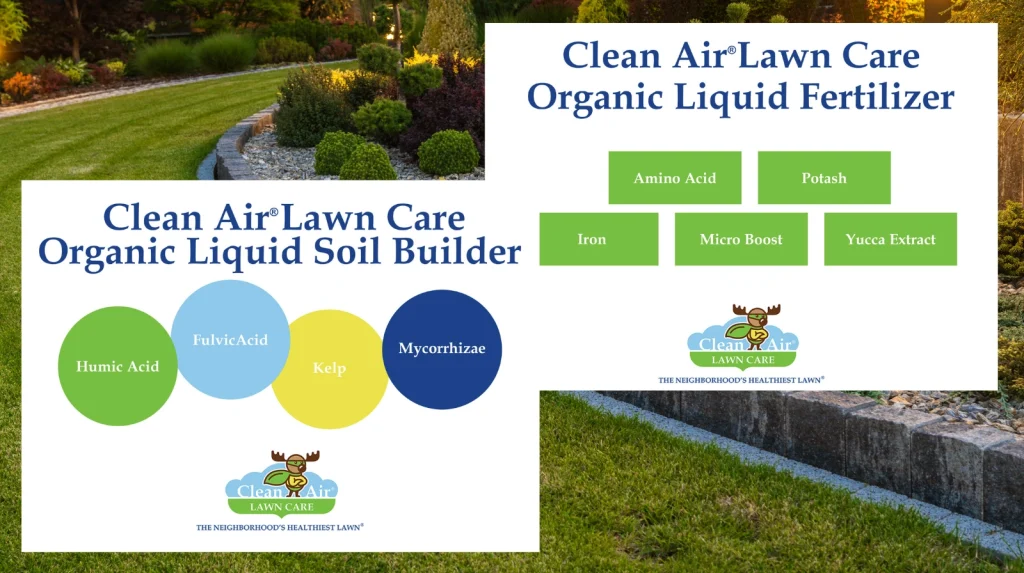
Humic and fulvic acid, leonardite. They’re on a lot of labels. CSU’s organic fertilizer materials don’t cover them, so we won’t attach a performance claim to them. If a company tells you these are the key to their program, ask what they’re citing.
How does organic fertilizer feed the soil?
When organic material goes down, grass roots can’t use it. CSU Extension: nutrients in organic fertilizers “are often in a form inaccessible to plant uptake and need to be converted by soil microorganisms into bioavailable forms before plants can uptake these nutrients.”
CSU’s PlantTalk describes the converters: “Earthworms and microorganisms transform fertilizer nutrients from one form to another, making the nutrients available to plants.” And separately: “Earthworms also aerate the soil, which helps preserve an air-water balance important for plant growth” (PlantTalk 1603).
So: you feed the soil organisms, they feed the grass, and the soil gets structurally better while it happens. Synthetic fertilizer skips the middle step and delivers to the plant directly. That’s faster and it works. It just doesn’t add anything back.
How does organic fertilizer change soil over time?
PlantTalk: organic materials “break down into humus that builds the soil structure and moisture- and nutrient-retaining capabilities” (PlantTalk 1619).
It matters more here, because of the constraint CMG #210 identifies: “Soil compaction is the primary factor limiting plant growth in landscape soils.” Better structure means more pore space, so water and roots can move.
One caution CSU is firm about: build organic matter gradually over years, not in one heavy application. There’s no front-loading it.
When does organic fertilizer not work well?
Release depends on microbial activity, which depends on temperature and moisture. Organic feeding slows when conditions slow. CSU: “Dry and/or cold soil conditions will delay the release of nutrients from these organic sources.”
An early-spring organic application doesn’t behave like a synthetic one. That’s a real limitation, and it’s why timing matters more in an organic program.
The part Luke and I never get tired of is digging into a yard we’ve worked for a few seasons and finding soil that actually crumbles instead of coming up in one hard chunk. You can feel the difference with your hands well before you can see it in the grass. If you’re curious what’s under your own lawn, we’ll take a look with you.
Clean Air Lawn Care Northern Colorado is owned by Dianne, Paul, and Luke DeLongchamps — a family business serving Fort Collins, Windsor, and Timnath with organic lawn treatments and solar-powered electric equipment.

