
Author: Dianne DeLongchamps
How do I tell grub damage from fungus damage in my lawn?
Cut a flap and look, don’t rely on a tug test. Both white grubs and necrotic ring spot destroy roots, so turf that lifts like loose sod could be either. C-shaped white larvae in the top 1 to 3 inches of soil means grubs. No grubs, plus dark rotted roots and crowns, points to necrotic ring spot. Shape is your best first clue.
Luke cuts these flaps across Fort Collins, Windsor, and Timnath. Grubs are the one lawn insect that reliably turns up here; the others are uncommon. Clean Air Lawn Care confirms what’s under the turf before treating anything. Two habits do more than any product. Never cut below 3 inches, 3.5 in July and August. Water 1 to 2 inches a week, across two to three deep waterings.
Why doesn’t the lift test tell you which problem you have?
CSU describes grub-damaged turf as lifting “as if it had been newly laid sod.” True.
But CSU 2.900 describes necrotic ring spot as causing “extensive root and crown discoloration and rotting,” which “reduces the plant’s ability to absorb water and nutrients.” Necrotic ring spot is a root and crown rot. That turf lifts too.
And PlantTalk 1528 calls necrotic ring spot “the most common lawn problem in Colorado.” So the most likely disease in your yard produces exactly the symptom the internet says means grubs.
How do I check my lawn for grubs?
At the edge of a damaged patch, cut three sides of a 12-inch square with a spade. Pry the flap back like a rug corner and look.
Grubs: C-shaped, cream-colored larvae with brown heads in the top 1 to 3 inches. CSU’s threshold is specific, “on drought-stressed turf, populations of nine or more grubs per square foot can produce visible injury.” One or two is background noise.
Necrotic ring spot: no grubs, and roots and crowns that look dark, discolored, and rotted rather than dried out.
Fold the flap back, step on it, water it. Now you know.
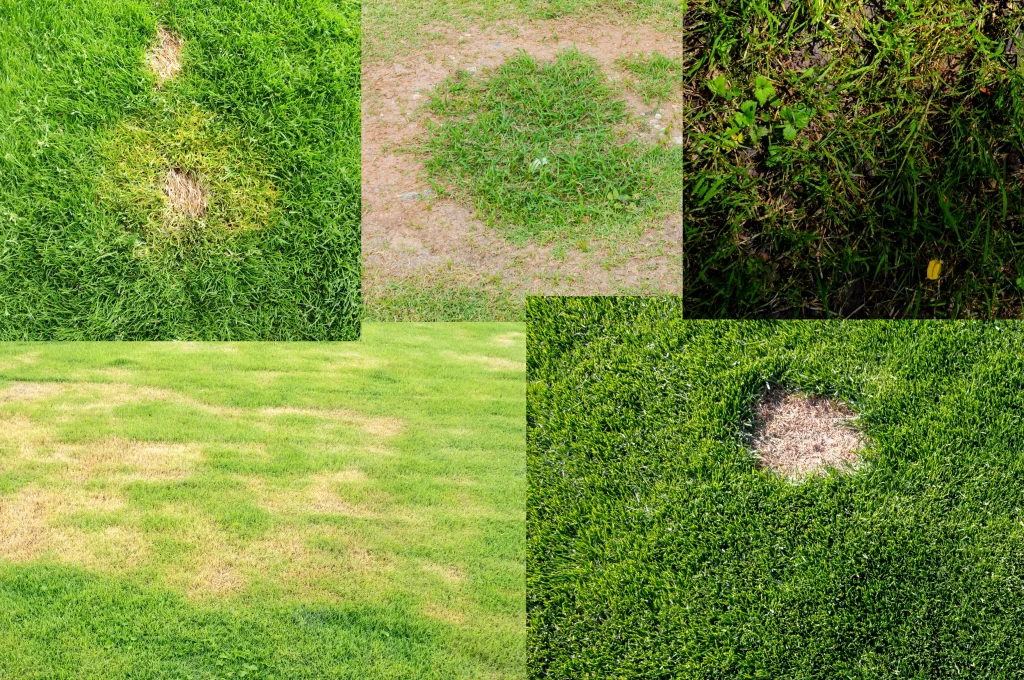
What does necrotic ring spot look like?
CSU describes it as “circular or doughnut-shaped patches of dead grass” ranging “several inches to several feet in diameter.” PlantTalk 1528 puts typical rings at “about one foot in diameter.”
The signature pattern is a doughnut, sometimes called a frog eye: “grass at the patch margin begins to die and becomes matted whereas the grass inside the ring remains healthy and green.” Older patches “often develop a bright yellow ring.” And necrotic ring spot is “caused by a fungus, but no mushrooms are associated with the ring.” No mushrooms doesn’t mean no disease.
Grub damage runs to irregular shapes with no clean geometry. CSU notes a second tell: “Heavy infestations of white grubs may kill grass or attract mammals, such as skunks, that damage grass when digging to feed on grubs.” Fresh digging overnight is a real signal.
Where in the yard does lawn fungus show up?
Not the shady corner. CSU ties necrotic ring spot symptoms to high heat and drought stress, “plants with damaged root systems suffer greater injury during high heat or drought stress, which is why visible symptoms often appear in July-August.” The patches look worst in the sun-baked parts of a lawn: the south-facing slope, the strip along the driveway.
When does the damage show up?
CSU’s treatment window for young southwestern masked chafer larvae is mid-July to early August. CSU also notes that “peak injury occurs in late summer and early fall”. The feeding and the visible damage aren’t the same date on the calendar.
Necrotic ring spot lags the same way. Root colonization happens at soil temperatures of 65 to 80°F, and the brown shows up weeks later when heat stress finishes the job.
Why does it matter which one you have?
An insecticide does nothing to a root rot, and a fungicide does nothing to a grub. And CSU’s guidance for necrotic ring spot isn’t a spray at all, it’s cultural practices:
- Don’t overwater. CSU 2.900: “Do not overwater. This is perhaps the most important prevention practice for NRS.”
- Water to a 6- to 8-inch depth “as infrequently as possible, typically no more than twice weekly”
- Core aerate at least once a year
- Mow at 2½ to 3 inches
- Cap nitrogen at no more than 4 lbs per 1,000 sq ft per year
- Overseed with resistant varieties
That’s mostly the same list as good general lawn care. The line we come back to most, from CSU 5.516: “Lawns that are adequately watered and in good condition can often tolerate much of the injury caused by these insects.”
A lawn with real root depth and living soil absorbs a problem that flattens a stressed one.
Luke has cut a lot of these flaps over the years, and the honest surprise is how often there are no grubs at all under a patch everybody assumed was grubs. Looking beats guessing every time, and it costs you thirty seconds and one divot you’ll never find again by next week. If you’re in Fort Collins, Windsor, or Timnath and you’ve got a patch that doesn’t make sense, give us a shout.
Clean Air Lawn Care Northern Colorado is owned by Dianne, Paul, and Luke DeLongchamps — a family business serving Fort Collins, Windsor, and Timnath with organic lawn treatments and solar-powered electric equipment.

