
Author: Dianne DeLongchamps
When should I treat for grubs in Colorado?
Mid-July through early August, per CSU Extension. That is earlier than most homeowners expect, and earlier than most lawn-care content will tell you.
Grubs are the pest Clean Air Lawn Care actually deals with in Fort Collins, Windsor, and Timnath — other insects are uncommon. We count before we treat. Luke’s baseline does more over a season than any application: mow at 3 inches minimum, 3.5 in July and August, and water 1 to 2 inches a week across two to three deep waterings.
CSU Fact Sheet 5.516 publishes the window by species:
| Pest | Target stage | CSU’s window |
| Southwestern masked chafer | young larvae | mid-July – early August |
| Japanese beetle | young larvae | July – early August |
| May/June beetles | young larvae | early June through July |
If you’re reading this in late August or September, that window has largely closed. We’d rather say so than sell you a treatment CSU says will mostly miss.
Why is the grub treatment window so specific?
CCSU’s principle: insecticide needs to be concentrated in the root zone “at the same time eggs are hatching and young white grubs are present.”
Adult beetles lay eggs starting in June, continuing “for about one and a half months.” The eggs hatch into small larvae feeding near the surface. That’s the moment they’re reachable.
Then the door closes: when “soils cool in autumn and approach 60°F,” grubs “move more deeply into the soil” to overwinter. Deeper grubs are harder to reach, and the damage often doesn’t show until spring.
Why can’t I cut my lawn as short as a golf course?
A tight, striped, carpet-short lawn looks incredible. It also isn’t your grass.
Golf greens are usually creeping bentgrass, or bentgrass mixed with annual bluegrass. That’s done with reel mowers, which cut with a scissoring action against a bedknife and, per University of Minnesota Extension, “provide the finest quality of cut available.” UMN also notes reel mowers “are not well adapted for use in higher heights of cut.”
The most typical mower found in a garage is a rotary. UMN: it “cuts the grass by impact, similar to the way a machete works,” giving “a rougher, more uneven cut.” Different plant, different machine. Cutting Kentucky bluegrass short with a rotary mower in a Front Range summer gives you a thin, scorched, weed-friendly lawn by August.
Does the kind of grub change the date?
CSU names the southwestern masked chafer, a white grub, as the species that “most often damages turf in communities along the Arkansas Valley, South Platte, and West Slope areas.” Fort Collins sits in the South Platte basin via the Cache la Poudre.
CSU notes that Japanese beetle now has “permanent, reproducing populations… in many communities along the Front Range of Colorado”, and for preventives CSU’s timing is earlier still: apply “just before eggs hatch or shortly after this time (typically mid-June to early July).”
May and June beetle grubs are larger, so it takes far fewer to do damage. CSU: “lawn injury by May or June beetle grubs can occur from populations of five or fewer grubs per square foot.”
How do I confirm I have grubs?
The lift check. CSU 5.516: “In severe infestations, turf roots are so severely pruned that areas of the lawn can be lifted or peeled back easily.” CSU’s AgBio group: damaged turf lifts “as if it had been newly laid sod.”
One limit: this tells you the roots are gone, not what took them. Necrotic ring spot, which CSU calls “the most common lawn problem in Colorado”, also rots roots and crowns.
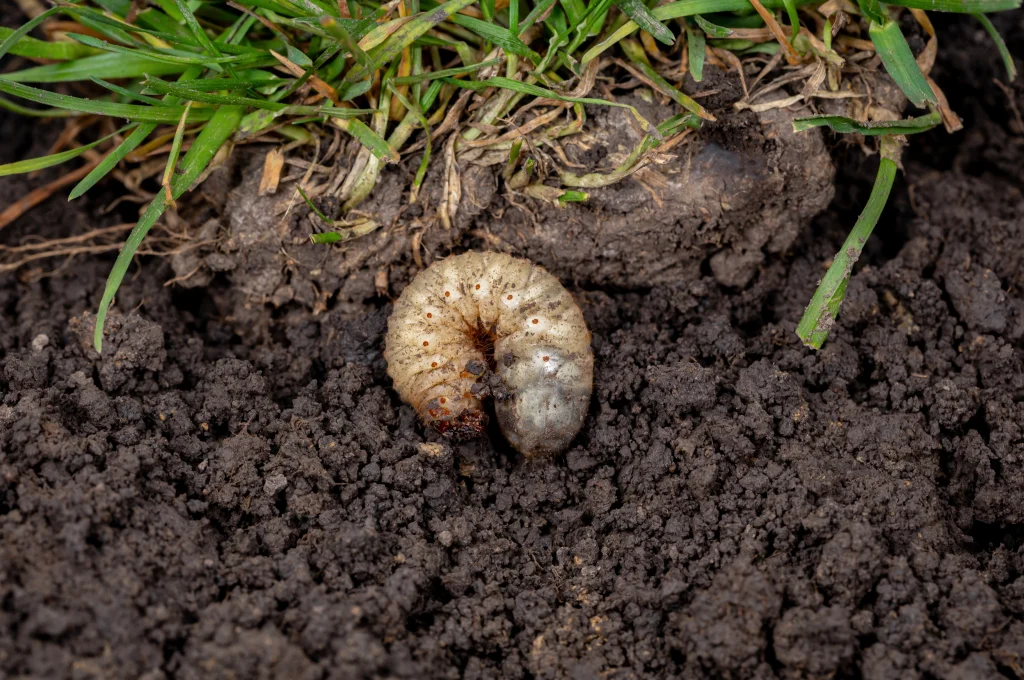
Cut a flap and look. Cut three sides only of a 12-inch square, pry the flap back, and inspect the root zone and top 1–3 inches of soil. CSU PlantTalk: “fat, C-shaped, whitish grubs.”
Count them. CSU’s benchmark: “On drought-stressed turf, populations of nine or more grubs per square foot can produce visible injury.” A handful is normal.
Watch for diggers. CSU 5.516 Quick Facts: “Heavy infestations of white grubs may kill grass or attract mammals, such as skunks, that damage grass when digging to feed on grubs.” Raccoons too, CSU notes they “often cause more damage” than the grubs did.
Does a healthy lawn resist grubs on its own?
CSU 5.516, Quick Facts: “Lawns that are adequately watered and in good condition can often tolerate much of the injury caused by these insects.”
That’s the whole argument for how we manage lawns, in CSU’s words.
CSU lists a tool that fits our approach: “Insect parasitic nematodes are a biological control option for both white grubs and billbugs.” CSU names Heterorhabditis bacteriophora as “the primary nematode species used for white grub control.”
What should I do if it’s already late August?
- Confirm what you have. Cut a flap and count. It’s the easiest time of year to identify the problem.
- Put mid-July on next year’s calendar.
- Spend this fall on recovery. Aeration, overseeding is what to focus on. CSU’s optimal Front Range seeding and fall fertilization window is mid-August to mid-September.
- Fix the stress that made it vulnerable. Mowing height and watering depth beat a mistimed application over a season.
See what our organic program includes: https://cleanairlawncare.com/services/organic-lawn-fertilization/
Grubs are the pest we actually deal with here. Luke’s read after years of routes across Fort Collins, Windsor, and Timnath is that white grubs are the main event and the other lawn insects people worry about are rare in our area, which is why this post is about grubs and not a list of ten pests you’ll probably never see. CSU says the treatment window closed in early August. If you’ve got a suspicious patch, do the flap check and call us for a second set of eyes. Either way, mid-July goes on next year’s calendar.
Clean Air Lawn Care Northern Colorado is owned by Dianne, Paul, and Luke DeLongchamps — a family business serving Fort Collins, Windsor, and Timnath with organic lawn treatments and solar-powered electric equipment.

