
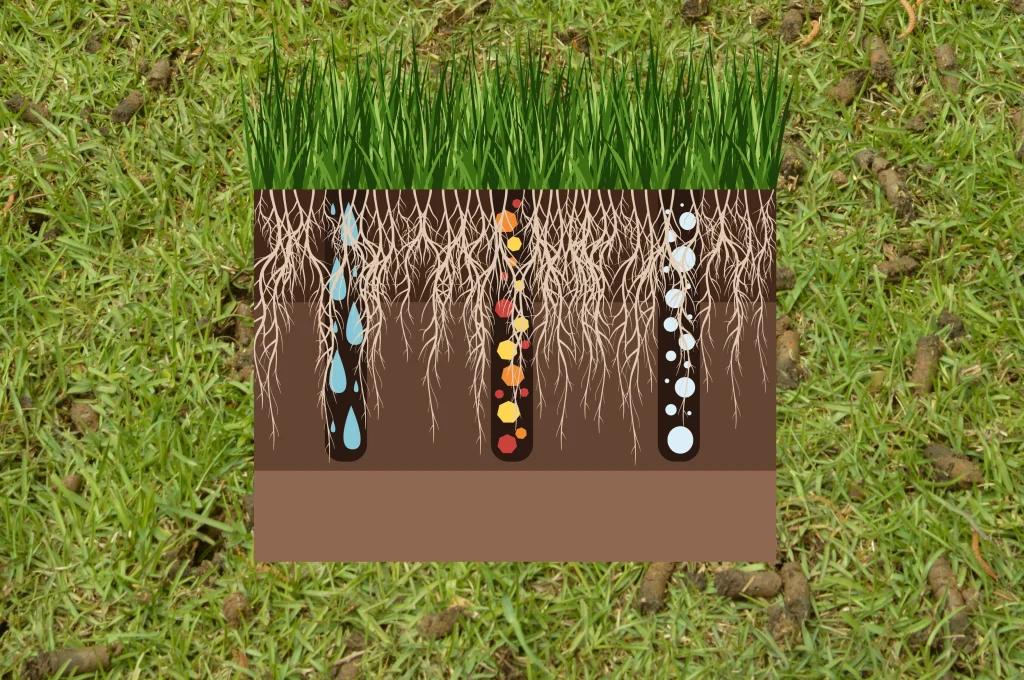
What actually happens during core aeration?
Core aeration uses a machine with hollow tines that pull real plugs of soil, roots and thatch out of the lawn, leaving holes behind that let air, water and nutrients reach the root zone. CSU’s PlantTalk program is specific that aeration only works well when actual cores or plugs of soil are pulled, with holes running about 2 to 3 inches deep and spaced 2 to 4 inches apart.
Diagnosing whether a lawn actually needs this, and how compacted it is, is something Luke walks through on a site visit for homeowners across Fort Collins, Windsor and Timnath. Heavy clay soil, the kind most yards here sit on, compacts every year from mowing, foot traffic and Colorado’s freeze-thaw winters. That’s part of why CSU describes aerating once or twice a year as normal maintenance, not a one-time fix.
The process, step by step
- A core aerator rolls across the lawn, with hollow tines punching into the soil rather than just poking solid holes.
- Each tine pulls out an actual plug of soil, thatch and roots, running about 2 to 3 inches deep.
- The plugs land on top of the lawn, where they can break down naturally, or get run over later with a mower (which will dull the blade a bit faster).
- The holes stay open long enough for water, air, nutrients, and any overseeded grass, to reach the compacted root zone directly.
Why core aeration beats spike aeration
The difference is whether soil actually leaves the lawn. Spike aeration just pokes solid holes without removing material, which can push soil sideways around the hole instead of relieving compaction. Core aeration physically pulls material out, which is why CSU Extension guidance centers on it instead of spiking.
What aeration does, and doesn’t, do for thatch
Aeration is often described as a thatch fix, and CSU Extension’s own Lawn Care Basics guidance, written by turf specialist Tony Koski, puts a real number on it: a single aeration pass, with tines spaced about 2 inches apart, removes roughly 10 percent of a lawn’s thatch. That’s a genuine reduction, not a full fix, which is why CSU frames aeration as one part of managing thatch rather than a one-time cure. The same guidance says it’s worth working to slow thatch buildup once the layer passes 1/2 inch thick.
Why Colorado clay needs this every year
Clay particles pack tightly, especially under regular foot traffic and the freeze-thaw cycle Colorado winters put soil through. Unlike sandy soil, which stays naturally looser, clay re-compacts over the course of a single growing season. That’s why CSU recommends aerating once or twice a year instead of every few years.
How aeration is different from dethatching
Aeration and dethatching (sometimes called power raking) get confused a lot. CSU’s guidance is a useful check on both: a thin thatch layer under 1/2 inch is normal and not something to chase down, and deep power raking can actually damage a lawn, sometimes removing a good chunk of living turf along with the thatch. Light, occasional power raking has its place, but reaching for aggressive dethatching as a first move on a lawn that mainly needs compaction relief can do more harm than the thatch itself was doing.
The long-term payoff of staying consistent
A single aeration helps for a season, but the real benefit shows up after a few years of staying on schedule. Water starts soaking in evenly instead of pooling in low spots, roots reach deeper into soil that used to stop them a couple inches down, and the lawn holds up better through the hottest, driest stretch of a Colorado summer. That compounding effect is part of why we treat aeration timing as connected to the rest of a lawn’s care, not a once-and-done task.
How this connects to what Luke looks for on a site visit
Before recommending anything, Luke checks how compacted a lawn actually is, rather than assuming every Fort Collins, Windsor or Timnath yard needs the same treatment. That usually means a simple screwdriver test: if a screwdriver won’t push a few inches into moist soil without real effort, compaction is likely part of what’s holding the lawn back, whether the visible symptom is thinning grass, water runoff, or a generally tired-looking yard.
Aeration is one of those things that’s genuinely satisfying to understand once you see what’s happening underground, and it’s a big part of what Luke walks people through on a site visit. If you’re not sure whether your Fort Collins, Windsor or Timnath lawn’s soil is telling you it needs a look, we’re glad to help you figure that out.
Clean Air Lawn Care Northern Colorado is owned by Dianne, Paul, and Luke DeLongchamps — a family business serving Fort Collins, Windsor, and Timnath with organic lawn treatments and solar-powered electric equipment.

