
Author: Dianne DeLongchamps
Why does fall aeration matter so much for compacted Colorado soil?
Compacted soil squeezes shut the tiny gaps that roots, water, and air need to move through. CSU Extension’s own guidance explains that compaction reduces the total pore space in the soil and hits the larger pores hardest, the ones that let air and water move through in the first place, and that low soil oxygen from compaction is a primary factor limiting plant growth in landscape soils. For a lawn, where you can’t just till organic matter into the ground, the fix is aeration.
Fort Collins, Windsor, and Timnath sit on soil with a lot of heavy clay, which compacts more easily than sandy or loamy soil even before any foot traffic or construction gets involved. Luke DeLongchamps sees this constantly on turf-type tall fescue and Kentucky bluegrass lawns across the area: a lawn that’s being watered and fertilized the right way but still struggling, because water and nutrients can’t get past a compacted layer to reach the roots. Clean Air Lawn Care performs core aeration for Fort Collins, Windsor and Timnath customers, paired with overseeding and compost topdressing, in both fall and spring.
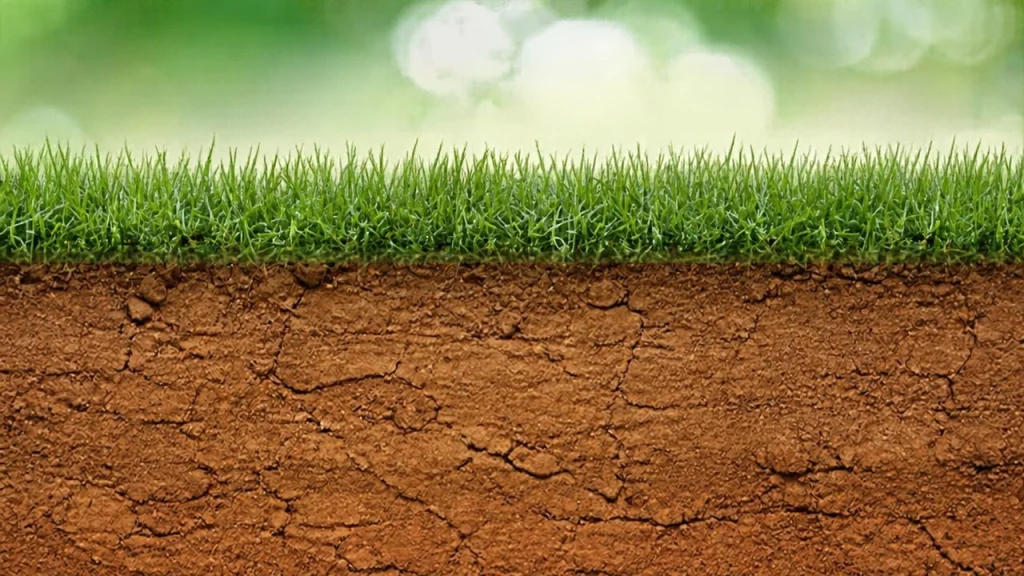
What compaction is doing underground
Compacted, clay-heavy soil pushes roots to stay shallow, which means weaker growth and less ability to handle stress. Shallow roots are also more vulnerable heading into winter, which connects compaction directly to the winterkill risk we’ve covered in another post.
What causes it in the first place
Soil usually gets compacted during home construction or from heavy traffic over time. Foot traffic on wet soil adds to it too, and CSU Extension notes that on fine-textured clay soils like ours, even falling rain and sprinkler irrigation compact the surface over time. Repeated mowing patterns, kids and pets using the same paths, and any past construction near the house are the usual culprits.
Newer Windsor and Timnath lots carry a specific version of this problem. CSU Extension’s own turf management materials note that when sod gets laid over soil that was compacted during construction, a thatch problem typically develops within a couple of years, on top of whatever compaction is already sitting underneath. Luke sees the same pattern in the field: construction traffic compacts the ground, the original topsoil often ends up buried under sterile fill, and sod goes down over it with little amending. That combination is exactly why newer lawns in the area sometimes need aeration sooner and more often than older, established ones.
Why aeration is the fix
Aeration pulls small plugs of soil out of the lawn, which lets water soak in better, helps break down thatch, gets more oxygen to the roots, and works organic matter back into the soil. It’s the direct fix for compaction. PlantTalk Colorado’s target is 2 to 3 inches deep and no more than 2 to 4 inches apart, with as many holes as possible across the lawn.
A few practical notes:
- Water the lawn the day before aerating, so the soil is moist enough for the aerator to pull deep plugs instead of shallow ones.
- Mark sprinkler heads first, so they don’t get damaged.
- Leave the plugs on the lawn if there’s more than 1/2 inch of thatch, since working them back in helps break it down. Otherwise they can be left on the lawn or removed either way.
- Pair it with seeding. Those aeration holes make great little pockets for new seed to take root, which is exactly why fall aeration and fall overseeding work so well together.
Prevention matters more than correction
Once soil is compacted, it’s genuinely hard to fix, which is why the bigger goal is preventing it in the first place. That doesn’t mean aerate once and you’re done, though. On Front Range clay, compaction tends to creep back over time, so this is more of an ongoing habit than a single repair.
If your lawn feels more like a driveway than a yard, you are not imagining it, and it is almost never something you did wrong. It is just what Front Range clay does over time without a little help. If a Fort Collins, Windsor or Timnath lawn of yours feels hard underfoot this fall, let’s talk about getting it aerated before winter.
Clean Air Lawn Care Northern Colorado is owned by Dianne, Paul, and Luke DeLongchamps — a family business serving Fort Collins, Windsor, and Timnath with organic lawn treatments and solar-powered electric equipment.

