
Author: Dianne DeLongchamps
What’s the difference between fall cleanup and winterizing my lawn?
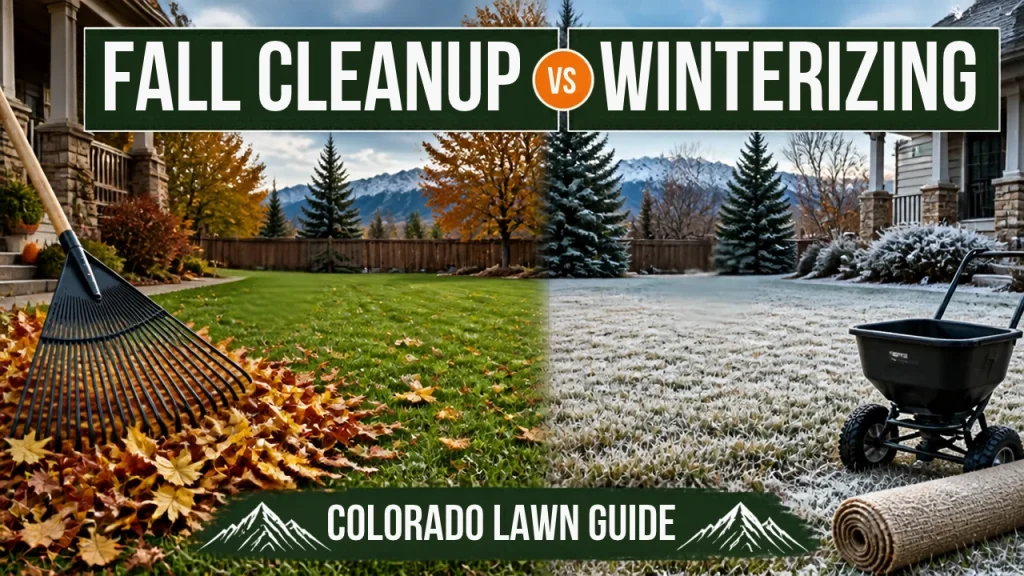
Fall cleanup is the work you do while your lawn is still growing: your last mows, fall watering, leaf management, and a fall weed treatment. Winterizing comes later, closer to the first hard freeze: shutting down the sprinkler system and switching to occasional winter watering. The two jobs happen in order, not at the same time.
Luke DeLongchamps, who runs the field side of our business, says the mistake he sees most often is shutting off the sprinkler system too early. In his experience, a system can survive a light freeze, and the stretch from September into October is an important recovery period for grass. Our own sprinkler shutoffs normally begin in October, once nights start freezing.
We split our own fall work with clients in Fort Collins, Windsor, and Timnath the same way. Luke handles the cleanup-phase visits, treatment timing, mowing guidance and leaf calls, through most of fall. Winterizing tasks like the sprinkler shutdown start near the end of October.
Why the order matters
Treating a lawn works because the plant is still actively taking things up, which is why cleanup tasks come first, while the lawn is still responsive. Winterizing tasks, especially the sprinkler shutdown, are timed against the weather itself instead of the lawn’s biology, since the risk there is frozen pipes, not a missed growing window. Treating the two as one job is how people end up skipping steps in both. Doing winterizing too early, like shutting off water while the lawn still needs it, or doing cleanup too late, like treating weeds after the ground’s already frozen, both waste the effort. Luke sees this most often with the sprinkler system itself: homeowners who shut theirs off at the first cool morning, well before a hard freeze is actually close, end up cutting their lawn’s and trees’ fall watering short during weeks when root growth still depends on it.
What belongs in fall cleanup
Every item below happens while the grass is still green and growing, and Colorado State University (CSU) Extension and PlantTalk Colorado publish guidance on each one.
- Mowing: Keep cutting at your usual height. PlantTalk Colorado’s mowing guidelines give a preferred height of two inches to three and one-half inches for Colorado turfgrass, and say there is no reason to change mowing heights during the year.
- Watering: PlantTalk Colorado’s fall watering page puts the need at 0.5 to 1 inch of irrigation per week during September and October. It calls fall an important time for turf to “heal” after a stressful summer.
- Leaves: CSU Extension says leaves can be mulched directly into a lawn with a lawn mower. Its test is simple: if you can see some grass through the leaves, the layer is not too thick to mulch.
- Fall feeding: PlantTalk Colorado’s fall fertilization page says to fertilize with nitrogen sometime from late September to early November at lower altitudes, and says the turf must be green when the nitrogen goes on.
- Weeds: PlantTalk Colorado’s fall weed control page says fall sprays effectively kill weeds such as dandelion, plantain, thistle, and bindweed, and calls late summer and early fall an ideal time to deal with many lawn weeds.
What belongs in winterizing
Winterizing tasks follow the weather instead of the grass.
- Sprinkler shutdown: CSU Extension’s guide to preparing a sprinkler system for winter explains the reason. Water expands by one-eleventh when it freezes, and that force is enough to burst pipes and fittings. The guide calls compressed air the only positive way to be sure enough water has been expelled, and it says not to trust manual or automatic drain valves.
- Winter watering: CSU Extension’s fall and winter watering fact sheet says to water during extended dry periods without snow cover, about once or twice each month, and only when air and soil temperatures are above 40 degrees.
A simple way to know which phase you’re in
If your grass is still green and putting out new growth, even slowly, you’re in fall cleanup. Once a hard freeze has genuinely knocked growth into dormancy for the season, you’ve crossed into winterizing. Most Front Range yards spend several weeks in the cleanup phase through September and into October before winterizing tasks take over. The cleanup jobs are covered in our posts on when to mow your lawn for the last time this fall, how much water your lawn needs in early fall, whether to rake, mulch, or bag fallen leaves, and why fall is the best time to deal with dandelions. The winterizing jobs are in our post on how to winterize your lawn before the first freeze.
We think about fall as two jobs, not one, because treating it as a single rush to “get the yard ready for winter” is how the details get missed. Luke and I would rather take each property in Fort Collins, Windsor, and Timnath through both phases properly than cut corners trying to do it all in one visit. If you’re not sure which phase your own lawn is in right now, ask us.
Clean Air Lawn Care Northern Colorado is owned by Dianne, Paul, and Luke DeLongchamps — a family business serving Fort Collins, Windsor, and Timnath with organic lawn treatments and solar-powered electric equipment.

