
Author: Dianne DeLongchamps
What is solar-powered lawn care, and how does it actually work?
Solar-powered lawn care means some of the electricity that charges a company’s equipment batteries comes from solar panels. The U.S. Energy Information Administration explains that a photovoltaic cell is a nonmechanical device that turns sunlight directly into electricity, and that photovoltaic systems can charge batteries to supply power when the sun is not shining.
At Clean Air Lawn Care, our own treatment equipment runs on electric power, charged in part by solar, as we do our organic lawn work across Fort Collins, Windsor, and Timnath. It is part of why we can say, honestly, that what we do produces zero tailpipe emissions in your yard, not just quieter emissions. It is also the kind of detail we are happy to talk through with anyone who asks how it actually works rather than just taking our word for it.
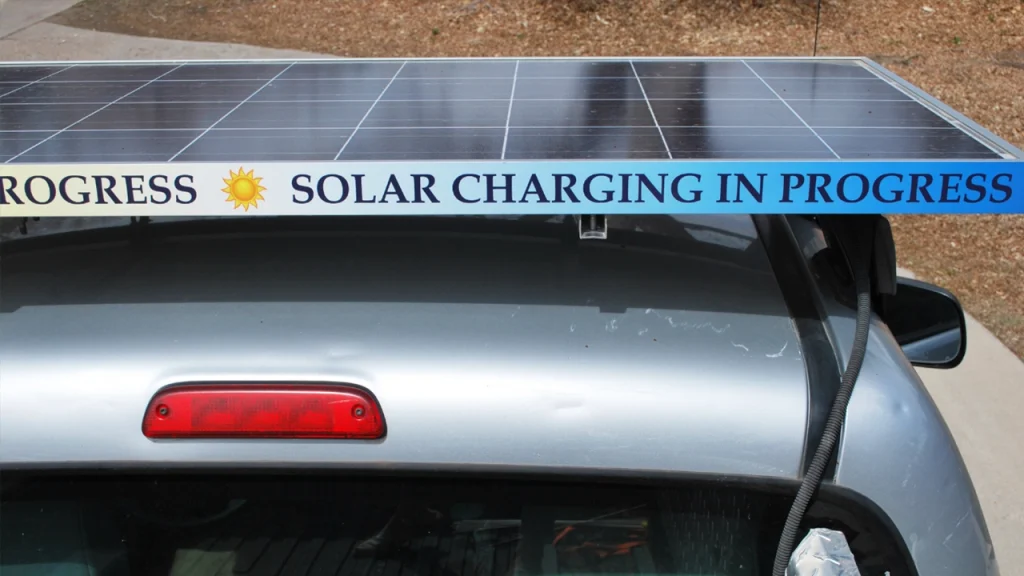
Luke, who runs our field work in Fort Collins, Windsor, and Timnath, says our equipment has always been all electric and that our rigs carry a solar panel so the batteries can charge on the move. The tradeoff is time. Batteries take 30 to 60 minutes to charge, so Luke budgets batteries carefully to avoid downtime in the field.
How solar charging actually works, in plain terms
The U.S. Energy Information Administration (EIA), the statistics and analysis arm of the U.S. Department of Energy, explains that a photovoltaic cell, also called a solar cell, is made of semiconductor material. Only the sunlight the material absorbs produces power. When the material absorbs enough energy, electrons are knocked loose. Treatments on the front surface of the cell push those free electrons toward that side, and the resulting charge imbalance creates a voltage, similar to the terminals of a battery. When the cell is connected to an external circuit, current flows.
A single cell is small, roughly 0.5 to about 4 inches across, and produces only about 1 or 2 watts. So cells are wired together in a sealed, weather-resistant unit called a panel, and panels are grouped into arrays, which can range from two panels to hundreds. The number of cells or the surface area of a panel determines how much power it produces.
Cells produce direct current. For the electric grid, inverters convert that direct current to alternating current. For our purposes, the part that matters is the one EIA mentions last: photovoltaic systems can charge batteries to supply power when the sun is not shining.
Sunlight and panel angle
EIA says panels produce the most power when they face the sun. Trackers that follow the sun can help, but they are expensive, so most systems are fixed, usually facing south in the Northern Hemisphere at an angle chosen to get the most from the sun. EIA also reports that the efficiency of commercial panels was under 10% in the mid-1980s, rose to about 15% by 2015, and is now approaching 25% for advanced modules.
Why pair solar with electric equipment at all
Electric equipment already eliminates tailpipe emissions at the point of use, regardless of where the electricity comes from. Charging with solar power takes that further by cutting how much of that charging relies on the broader grid. The Colorado grid mix is covered in our post on whether electric lawn equipment really reduces your carbon footprint.
What EIA says solar does and does not do
EIA states that solar technologies “do not produce air pollution or greenhouse gases when operating,” and that solar can also offset emissions indirectly when it replaces sources that produce harmful emissions. The agency is also direct about the other side of the ledger. Making solar equipment takes a lot of energy, and manufacturing photovoltaic cells and panels involves hazardous chemicals that must be handled carefully. According to EIA’s page on solar energy and the environment, studies suggest a photovoltaic system can generate energy equal to the energy used to manufacture it within 1 to 4 years, and most systems run for 30 years or more.
What this means for clients
You do not need to install anything or think about batteries at all. What you see is the result: equipment that runs quiet and produces zero tailpipe emissions, arriving already charged, doing organic treatment work on your lawn without gas fumes drifting over the fence. Luke says the most common reaction from new customers is pleasant surprise at how much quieter the equipment is and at the lack of engine fumes. The panel on the rig gives Luke another way to keep batteries topped off between yards, since a full charge takes 30 to 60 minutes.
If you want to know how the solar charging works on our rigs, just ask us.
Clean Air Lawn Care Northern Colorado is owned by Dianne, Paul, and Luke DeLongchamps — a family business serving Fort Collins, Windsor, and Timnath with organic lawn treatments and solar-powered electric equipment.

