
Author: Dianne DeLongchamps
Are more Colorado homeowners replacing lawns with drought-friendly landscaping?
The clearest evidence isn’t a survey. It’s the money running out. As of March 28, 2026, Denver Water’s turf-removal rebates for the year were already fully claimed, because they went fast. The state’s Turf Replacement Grant Program, run through the Colorado Water Conservation Board, stopped taking new applications in early 2025 because its funding was expected to run out after a Feb. 28, 2025 deadline. Fort Collins runs its own local rebate the same way: first come, first served. Programs running out of money before the season ends is a real, dated signal that demand is real, even without a formal study behind it.
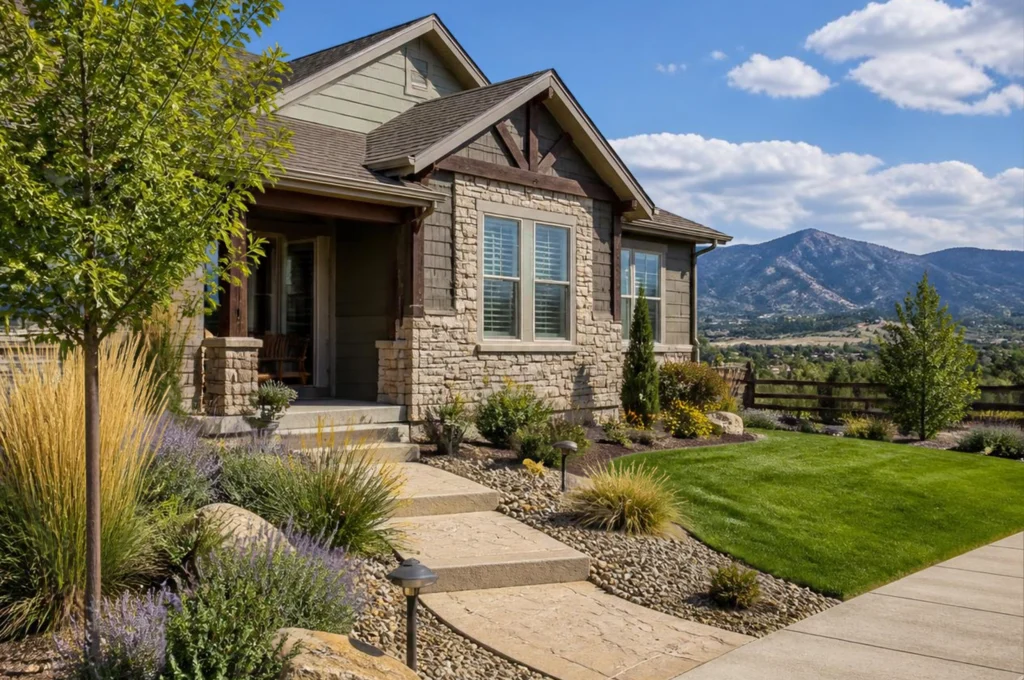
We treat the turf part of a lot of these hybrid conversions across Fort Collins, Windsor, and Timnath, keeping the remaining lawn of turf-type tall fescue or Kentucky bluegrass healthy on an organic program while the rest of the yard shifts to lower water use.
The clearest signs: programs running out of money
This isn’t a survey of what homeowners say they want. It’s a demand signal. Money set aside for turf conversion has run out faster than providers planned for, in more than one program at the same time. The Colorado Water Conservation Board’s turf grant program funded 49 eligible applicants across its two 2023 funding rounds before later rounds closed early to new applications. Denver Water’s own rebate, up to $750 per project, sold out for 2026 well before the year was over. Closer to home, Windsor runs its own Lawn Replacement Program, paying $1 to $2 per square foot of turf removed depending on project scope, capped at $2,000 per water account per year, but only for projects completed within the 2026 calendar year and only while funds last, on the same first-come, first-served basis as every other program on this list.
What’s making the shift easier right now
Two things are making this easier. Legally, Colorado’s SB23-178 removed a barrier that used to stop HOA homeowners from converting turf at all. It requires associations to allow at least 80% drought-tolerant plantings. Financially, Fort Collins’ own Xeriscape Incentive Program offers a rebate for turf conversion, which lowers the upfront cost of a project. CSU Extension also runs a dedicated Lawn Conversion resource hub with removal methods, design steps, and plant lists for homeowners doing a project themselves. Denver Water has a great resource to drought resistant grasses, water-wise plants, and more!
What homeowners are actually converting
CSU Extension’s own xeriscape principles point toward a partial conversion, not an all-or-nothing swap. The principles call for sizing a lawn to where it’s actually used, not letting it cover a whole lot by default. That matches what these rebate programs are built to fund: replacing a specific area of turf, not necessarily an entire yard.
What to do if you’re considering a conversion
Check your HOA’s rules first, since SB23-178 only guarantees certain minimums for single-family detached homes. Check current rebate availability directly with your city or water provider, since these programs run first come, first served and can close mid-season, and the rules aren’t identical town to town: Windsor’s program pays per square foot with an annual cap and a hard 2026 completion deadline, while Fort Collins pays a flat rebate with its own native-plant bonus. Don’t assume one town’s numbers apply to a Timnath or unincorporated-Larimer-County address; confirm with your own provider before budgeting a project around a specific rebate. And consider a hybrid design that keeps a smaller lawn rather than removing turf altogether. That’s the direction CSU’s own principles point toward anyway.
How Clean Air Lawn Care supports this shift
As more Fort Collins, Windsor, and Timnath yards move toward this right-sized approach, our role stays the same: keep the lawn part genuinely healthy with organic fertilization and mowing height advice, so the turf that remains earns its water.
We’ve had a front-row seat to how much Northern Colorado yards have changed in the past few years, and it’s genuinely exciting to see families find a balance that works for their water bill and their life. If you’re thinking about where to start, we’re happy to walk your yard with you and talk through the lawn treatment side of the plan.
Clean Air Lawn Care Northern Colorado is owned by Dianne, Paul, and Luke DeLongchamps — a family business serving Fort Collins, Windsor, and Timnath with organic lawn treatments and solar-powered electric equipment.

