
Author: Dianne DeLongchamps
Are electric lawn mowers actually as good as gas mowers?
They are close, but not identical. Consumer Reports’ 2026 comparison scored gas slightly higher for cut evenness (4.7 out of 5, versus 4.5 for battery) and for mulching (4.7 versus 4.6), with side discharge nearly identical. Electric pulls ahead on noise, upkeep, and exhaust, so the right choice depends on what matters most to you.
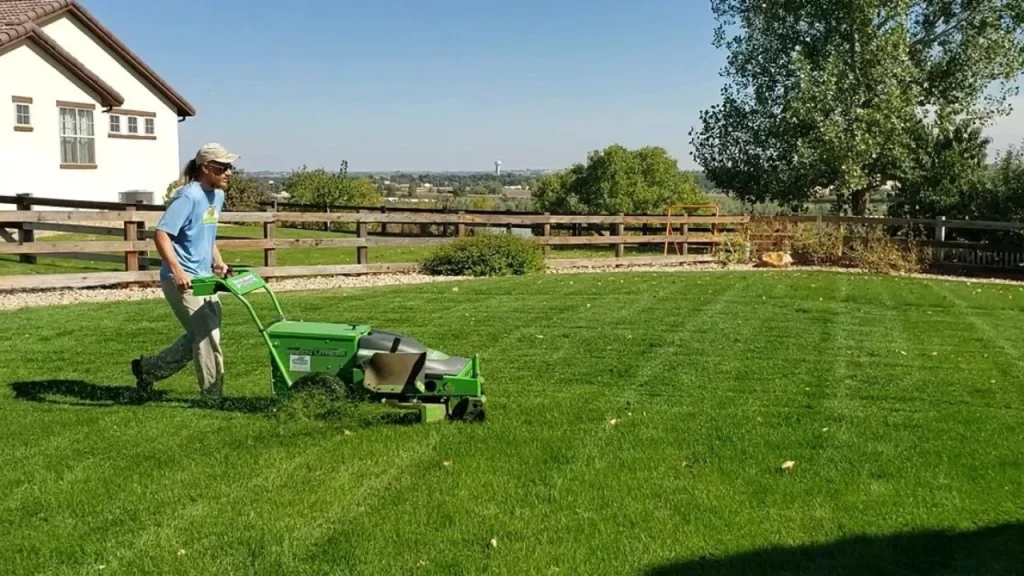
Luke DeLongchamps, who runs field work for Clean Air Lawn Care in Fort Collins, Windsor, and Timnath, says the real tradeoff with battery equipment is charging time. Batteries take 30 to 60 minutes to charge, so the team budgets batteries carefully to avoid downtime in the field, and the rigs carry a solar panel so batteries can charge on the move.
Clean Air Lawn Care is an organic lawn treatment company, fertilizer and weed control for homes in Fort Collins, Windsor, and Timnath, and Luke handles estimates and field work. Our own equipment, the sprayers we use to apply fertilizer and weed treatments, runs on electric power charged in part by solar.
What Consumer Reports actually found
Consumer Reports’ gas versus battery comparison, updated May 4, 2026, tested gas and battery push mowers side by side on cut quality, mulching, bagging, and side discharge. Gas scored very slightly ahead for even cutting, with an average of 4.7 to electric models’ 4.5, and for mulching, 4.7 to 4.6. For bagging, Consumer Reports says both earn great scores, with a few gas models reaching 4.6 against the electric models’ top score of 4.5. The averages for side discharge are nearly identical, a solid “very good.”
The article’s practical takeaway for most households is that a fully charged battery walk-behind mower will finish the job on an average lawn, the same as a gas one. It also says that if your mowing noise disturbs nearby neighbors, an electric mower offers a solution.
Runtime is the real tradeoff, not power
Consumer Reports found the average battery walk-behind mower ran 45 to 50 minutes per charge. That could easily handle a quarter acre, even on somewhat sloped land, and on flat, unobstructed ground it might cut half an acre. A gas mower runs as long as you keep fuel in the tank. Consumer Reports says you can extend an electric mower’s runtime by keeping another battery charged and ready to go.
A separate Consumer Reports article on electric mowers reports 30 to 60 minutes of run time on a charge, enough to mow 12,000 to 15,000 square feet, or about a quarter to a third of an acre. That article also says batteries are not cheap, at about $150 each. If your lot in Fort Collins, Windsor, or Timnath is larger than half an acre, plan on a spare battery or a gas mower.
The noise difference is not close
Noise is where electric separates itself. The scores and decibel numbers are in our post on whether electric lawn equipment is really quieter than gas equipment.
Maintenance and cost over time
Consumer Reports says gas mower tanks need to be refilled periodically, and the machines need seasonal maintenance, including draining or winterizing the fuel, checking or replacing the spark plugs, and changing the oil and filter. Short of occasional blade sharpening, it says electric mowers are largely maintenance-free.
On price, Consumer Reports says electric models are generally pricier up front and that you are more apt to find a great gas machine for a lower up-front cost. It also says electric models at lower and average prices can be more cost-effective than gas over time.
Mowing height matters more than the motor
Whichever mower you choose, the number that actually protects your lawn is the cutting height, not the fuel type. For the turf-type tall fescue and Kentucky bluegrass common here, we advise never cutting below 3 inches, raised to 3.5 inches in July and August when Colorado heat stresses the grass. That holds true whether the mower runs on gas, battery, or drives itself.
Our 3-inch floor sits at the top of CSU Extension’s range. PlantTalk Colorado’s mowing guidelines put the preferred height of Colorado turfgrass species at two inches to three and one half inches, and CSU’s lawn care fact sheet warns that mowing to less than 2 inches can decrease drought and heat tolerance.
Blade sharpness and the one-third rule
Blade sharpness matters just as much as height, regardless of what powers the mower. PlantTalk Colorado, from CSU Extension, recommends sharpening mower blades after every third mowing, or at the least once a month, and says the time between mowings can range from four to ten days depending on how fast the grass is growing. CSU’s lawn care fact sheet says a dull blade will shred and fray leaf blades instead of cutting them cleanly, and it says to mow often enough that no more than 1/3 of the grass height is removed at any single mowing.
Luke still gets asked this one at nearly every site visit. Our honest answer has not changed: pick the mower that fits your yard and your patience for maintenance. We would love to talk about your lawn’s treatment plan whenever you are ready.
Clean Air Lawn Care Northern Colorado is owned by Dianne, Paul, and Luke DeLongchamps — a family business serving Fort Collins, Windsor, and Timnath with organic lawn treatments and solar-powered electric equipment.

