
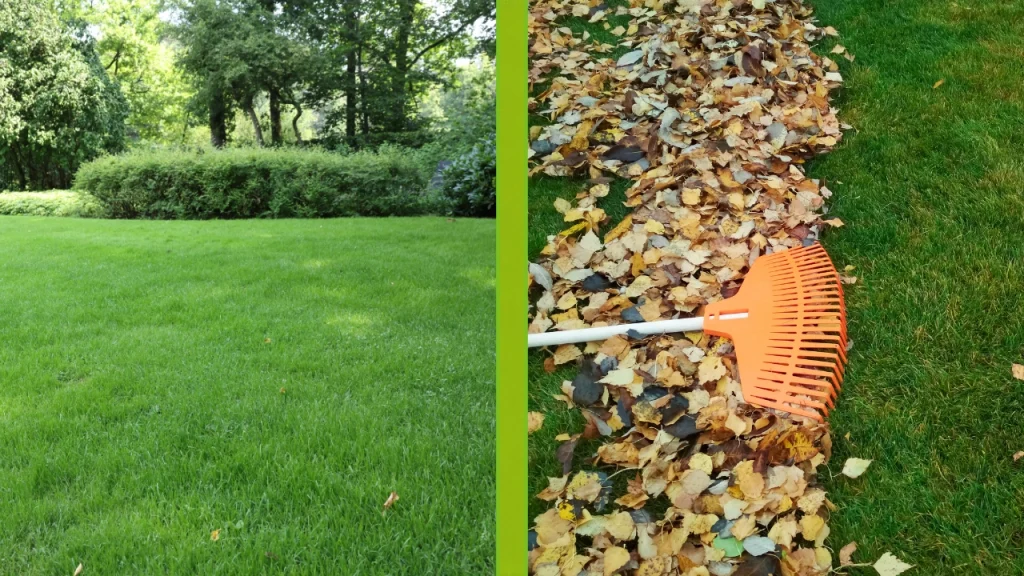
What changes between fall and summer lawn care?
Fall lawn care shifts away from heat and drought survival and toward building roots and getting ready for winter. Fertilizing focuses on roots and crowns instead of color, watering drops as temperatures cool, recommended mowing height comes back down from its summer peak without ever going below 3 inches, and the main local pest, the white grub, goes dormant as soil cools. It’s a different job than keeping a lawn alive through a Colorado July.
Luke walks Fort Collins, Windsor and Timnath properties through this shift every September. Treating fall like an extension of August is one of the most common ways a lawn misses its best growth window of the year. Clean Air Lawn Care’s organic, soil-building program adjusts with the season instead of running the same program all year.
How does fertilization change?
Summer fertilization, when it’s used at all, is mostly about holding color and helping a lawn handle heat stress without pushing tender new growth that struggles in high temperatures. CSU Extension’s fact sheet lists no nitrogen at all from July through early August for bluegrass and ryegrass lawns. Fall fertilization has a different job: building the root reserves that fuel next spring’s green-up, split across a mid-August-to-mid-September feeding and an optional October-to-early-November feeding, per CSU Extension’s Fact Sheet 7.202.
How does watering change?
Summer watering is about surviving heat and evaporation, and CSU Extension notes an established bluegrass or ryegrass lawn can need up to 2.25 inches per week in hot, dry, windy conditions. Clean Air Lawn Care’s field standard for the growing season is 1 to 2 inches per week across two to three deep waterings, stepping up to 2 inches during the mid-July-to-mid-August peak, then tapering back down as fall cools things off.
How does mowing height change?
Clean Air Lawn Care recommends never mowing below 3 inches, stepping up to 3.5 inches during the heat of July and August to shade the soil and protect roots. Once that summer heat breaks, the recommended height comes back down to the standard 3-inch floor rather than going any lower. CSU Extension’s own guidance recommends holding mowing height steady year-round instead of cutting shorter for fall, there’s no reason to mow turf shorter in late fall, which lines up with why Clean Air Lawn Care never recommends going below that 3-inch minimum at any time of year. Whatever the height, the same one-third rule applies at every mowing: never remove more than a third of the blade length in a single cut.
How does pest pressure change?
White grubs are the main lawn pest Luke sees in this area. Other lawn insects are uncommon here. CSU Extension calls white grubs the most damaging insect pest found in Colorado lawns generally, which lines up with why they’re the one Luke watches for. As soil temperatures cool in fall, white grubs move deeper into the soil and go dormant until spring, which is why fall pest pressure eases even as fertilizing and soil work ramp up.
What new priorities only make sense in fall?
- Core aeration, overseeding and compost topdressing, a service Clean Air Lawn Care performs for customers in both fall and spring, to relieve a summer’s worth of soil compaction and fill in thin spots while soil temperatures still favor germination. CSU Extension advises against seeding after the first fall frost, since young seedlings are more likely to die over winter. A lawn seeded too late should wait until spring instead.
- Leaf and debris cleanup, so matted leaves don’t smother grass or create damp, disease-favoring conditions over winter.
Why does this matter more for an organic program specifically?
An organic program depends on active soil life, so the fall window matters even more here than it might for a purely synthetic approach. Cooler soil in fall still supports real microbial activity, so this stretch is valuable working time, not just a wind-down before winter.
We build our whole calendar around this seasonal shift, because running a summer program into October just doesn’t set a lawn up for success. If you want a plan that adapts with the seasons here in Fort Collins, Windsor and Timnath, that’s what Luke and I aim to build for every property we treat.
Clean Air Lawn Care Northern Colorado is owned by Dianne, Paul, and Luke DeLongchamps — a family business serving Fort Collins, Windsor, and Timnath with organic lawn treatments and solar-powered electric equipment.

