
Author: Dianne DeLongchamps
How does Fort Collins’ first frost change my lawn care schedule?
Fort Collins usually sees its first light frost sometime in early October, with the exact date shifting from year to year. Frost doesn’t shut lawn care down, it shifts your priorities. Mowing slows down, your last weed-treatment window gets narrower, and watering goes from routine to occasional. None of it happens all at once.
At Clean Air Lawn Care, our own seasonal cue is the first run of nights that freeze in October. That is the signal that grass growth is slowing and the point when sprinkler shutoffs normally begin and our work shifts into fall and winter mode.
Fort Collins, Windsor, and Timnath sit close enough together that they share roughly the same frost timeline. Luke watches the extended forecast for Northern Colorado instead of working off one date on a calendar, because “average” and “this particular year” aren’t always the same thing.
What a light frost actually does to grass
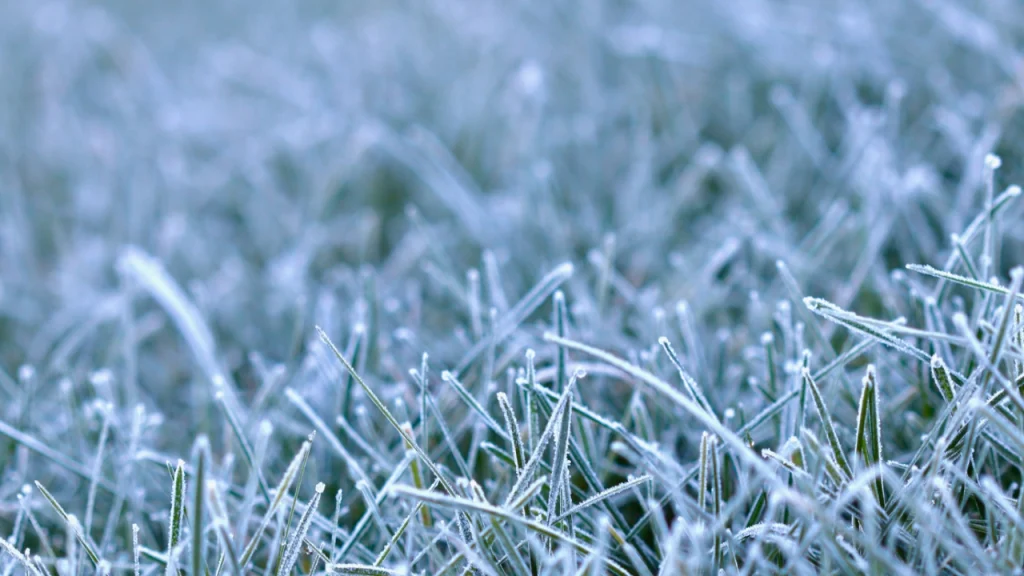
A light, 32-degree frost damages the leafy, actively growing part of the grass blade, while the crown and roots, sitting at or just below the soil surface, stay alive and start shifting into dormancy. You’ll usually see growth slow in the days before a frost, then drop off sharply once it hits, even though the roots keep working underground for a while longer.
How this changes your last weed treatment
CSU Extension’s PlantTalk Colorado page on fall lawn weed control says, “Late summer and early fall is an ideal time to deal with many lawn weeds,” and that fall herbicide sprays effectively kill weeds such as dandelion, plantain, thistle, and bindweed. CSU’s fact sheet on broadleaf weed control in lawns explains why: perennial broadleaf weeds are storing energy reserves in their stems and roots in fall, and a fall-applied herbicide enters the plant and travels to those plant parts with the food reserves. The same fact sheet gives early September to early November as the best time to apply a general-purpose broadleaf herbicide.
Temperature matters too. PlantTalk’s page on controlling broadleaf weeds says to use herbicides when temperatures are between 65 and 85 degrees Fahrenheit, and not when temperatures are expected to rise above 85 degrees within 24 hours of application. A light frost doesn’t close that window right away, but it does mean the clock is running. We apply Moose Juice, our bio-based weed blend, during this stretch while it can still reach actively growing leaves.
How this changes mowing
Mowing follows growth, not the thermometer. PlantTalk Colorado’s mowing guidelines say to keep mowing until the lawn stops growing, and that there is no reason to change mowing heights during the year. After a light frost, keep your mower at the same height and let the time between cuts stretch out as growth slows.
How this changes watering
Frost does not end the need to water. CSU Extension’s PlantTalk Colorado page on fall lawn watering says historic evapotranspiration and rainfall data for most of Colorado show a need of 0.5 to 1.0 inches of irrigation per week during September and October. The fuller breakdown is in our post on how much water your lawn needs in early fall. Shutting down and blowing out a sprinkler system is a separate, later step we cover on its own.
Why we don’t treat one frost as a hard deadline
One light frost is rarely the whole story for a Front Range fall. It’s common to get an early frost followed by two or three more weeks of mild weather that lets grass keep growing and treatments keep working. The Colorado Climate Center, which is part of Colorado State University, says that even with an average shift toward later freezes on the Front Range, an extremely early cold front can still arrive, as one did across eastern Colorado in September 2020. That is exactly why one early frosty morning is a data point, not a deadline. We adjust each property’s schedule to the weather that actually happens, not to the first cold morning.
Light frost versus a hard, sustained freeze
A single light, 32-degree frost and a sustained hard freeze are not the same event for a lawn. The light frost nips tender garden plants and slows grass growth, but cool-season turf like Kentucky bluegrass and tall fescue can keep working underground for weeks after it. It takes a run of nights well below freezing, not one frosty morning, to push a lawn fully into dormancy. The Colorado Climate Center also notes that Front Range and eastern plains locations have generally shifted one to two weeks later on first-freeze timing, which is one more reason a single early frost doesn’t tell the whole story.
October in Northern Colorado can hand you a 70-degree afternoon and a hard freeze that same night, sometimes in the same week. Luke tracks the forecast for every property we treat, because that’s the only way to get this timing right instead of guessing. If you want a second opinion on where your own yard stands, we’re glad to take a look.
Clean Air Lawn Care Northern Colorado is owned by Dianne, Paul, and Luke DeLongchamps — a family business serving Fort Collins, Windsor, and Timnath with organic lawn treatments and solar-powered electric equipment.

