
Author: Dianne DeLongchamps
Are organic lawn treatments as effective as synthetic ones for weeds and pests?
Not in the same way, and not on the same timeline. Synthetic products are formulated for fast, broad knockdown of an existing problem. Organic control works through prevention, turf density, correctly timed natural pre-emergents and targeted treatment. Over a full season the gap narrows considerably. On a single established infestation, synthetic acts faster.
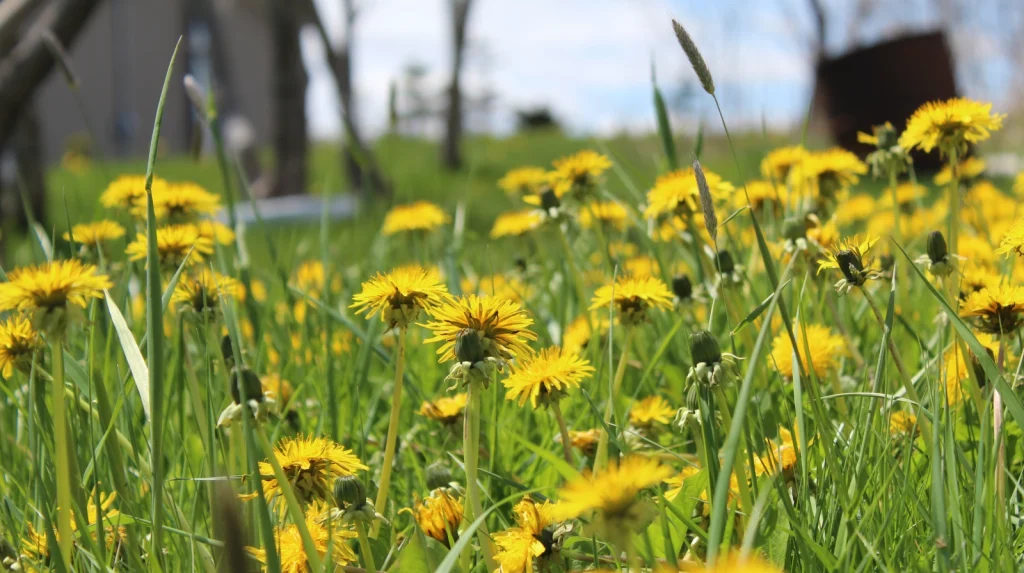
Here’s what that looks like on a Clean Air Lawn Care route in Fort Collins, Windsor and Timnath. Our natural weed control is natural pre-emergents applied on CSU’s mid-April window, plus Moose Juice, our own bio-based blend, for the clover and dandelions that come up all over Northern Colorado. Grubs are the pest that actually matters here; other lawn insects are uncommon. Luke’s baseline for every customer is 3 inches minimum mowing height, 3.5 in July and August. Turf signs go up after every treatment, as Colorado requires. Stay off the lawn 2 to 4 hours, or until it’s dry, whichever comes later.
Does corn gluten meal work as an organic weed killer?
Corn gluten meal is presented everywhere as the organic pre-emergent.
Oregon State University ran a two-year trial: “Corn gluten meal did not control any weeds in any trials under any circumstances over a two-year period” (Oregon State Extension).
CSU doesn’t list corn gluten meal among pre-emergent options for Colorado lawns at all. So we don’t build our program on it.
How does organic weed control actually work?
Natural pre-emergents, timed correctly. CSU PlantTalk gives the window: apply pre-emergent products “by mid-April in the northern Front Range” (PlantTalk 1541). Miss it by three weeks and you’re treating after germination, which is a much harder job.
Moose Juice for what breaks through. It’s made without synthetic herbicides, and it’s what we reach for on clover, dandelions and the other broadleaf weeds in Northern Colorado yards. Customers ask for it by name more than anything else we do.
Mowing high. The most underrated weed control tool there is, and it’s free. Taller grass shades the soil surface, and shaded soil germinates far less weed seed. CSU publishes two bands for Colorado species — PlantTalk 1515 says “the preferred height of Colorado turfgrass species is two inches to three and one half inches,” and Fact Sheet 7.202 says “the preferred mowing height for all Colorado species is 2.5 to 3 inches.” Our 3-inch floor is our own standard, sitting at the top of CSU’s range. CSU is clear about the other direction: mowing under two inches “can reduce drought and heat tolerance, and cause a higher incidence of insect, disease and weed pest problems.”
Edging vertically. A vertical edge keeps a clean line without scalping the turf edge down to bare soil, and bare soil is where weeds start. Worth asking whoever cuts your grass to do it that way.
Overseeding. Filling thin spots closes the gaps weeds were going to use.
How does organic pest control work in Colorado?
A lot of national pest advice aims at problems Colorado doesn’t have.
CSU: “White grubs are the most damaging insects that occur in Colorado.” Billbugs and chinch bugs are both uncommon here. Grubs are the real conversation.
Thresholds, not calendars. CSU has real numbers: “On drought-stressed turf, populations of nine or more grubs per square foot can produce visible injury.” And because May and June beetle grubs are much larger, “lawn injury by May or June beetle grubs can occur from populations of five or fewer grubs per square foot” (CSU Extension 5.516). You count before you treat. See [When Should I Treat for Grubs in Colorado?]
Condition is the first line of defense. CSU: “Lawns that are adequately watered and in good condition can often tolerate much of the injury caused by these insects.” The same grub count is a crisis in a stressed lawn and a non-event in a healthy one.
Beneficial nematodes are applied, not wished for. When treatment is warranted, they’re an active control we put down. CSU names Heterorhabditis bacteriophora as “the primary nematode species used for white grub control.” They’re a product with a timing window, not something that shows up on its own.
When does synthetic weed and pest control work better?
Got a heavy established dandelion population, or a grub count well over threshold with visible turf loss right now? A synthetic herbicide or insecticide knocks it down faster, in the same week. Speed of knockdown is theirs.
Fast knockdown treats what’s in front of you. It’ll be in front of you again next year unless the conditions change. We’re slower on the incident and aimed at the conditions.
Luke does most of the weed walking on these properties, and the thing he notices every year is that the lawns needing the least attention are almost always the ones being mowed the highest. It isn’t the exciting answer. It’s just the true one.
Clean Air Lawn Care Northern Colorado is owned by Dianne, Paul, and Luke DeLongchamps — a family business serving Fort Collins, Windsor, and Timnath with organic lawn treatments and solar-powered electric equipment.

