
Author: Dianne DeLongchamps
What is CSU Extension’s Lawncheck, and is it free?
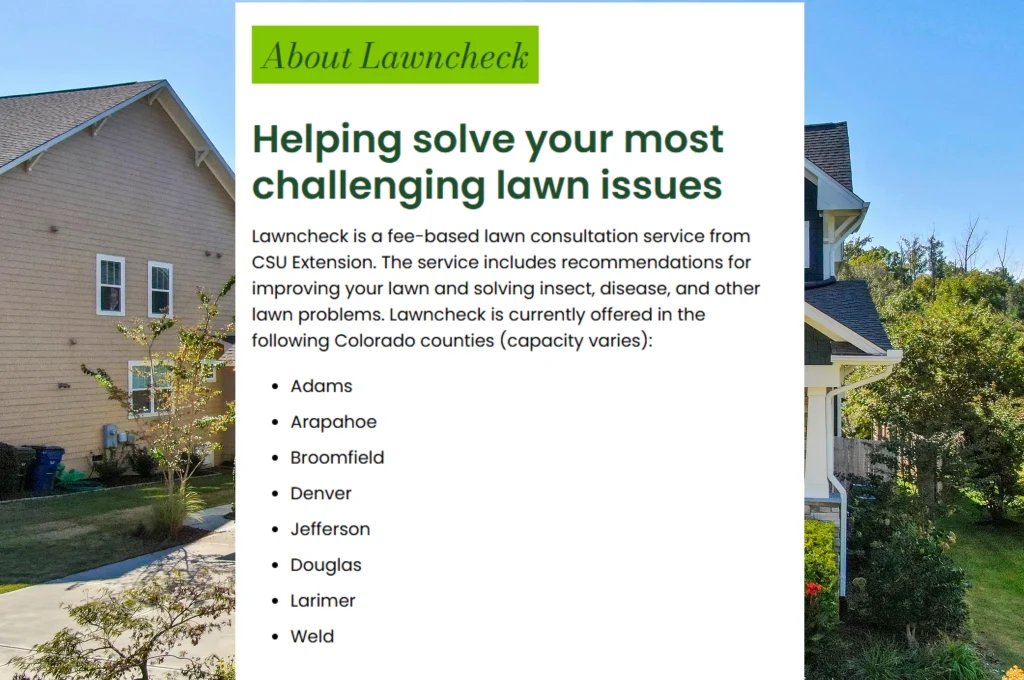
Lawncheck is a fee-based lawn consultation service from Colorado State University Extension. It is an in-person site visit, not an online tool. CSU’s own page describes it as providing “recommendations for improving your lawn and solving insect, disease, and other lawn problems,” supported by the CSU Turf Program in the Department of Horticulture and Landscape Architecture.
We’re Clean Air Lawn Care, organic lawn treatment in Fort Collins, Windsor, and Timnath, and we point people at CSU constantly. Most of what Luke tells a homeowner on a first visit costs nothing: mow at 3 inches minimum and 3.5 in July and August, water 1 to 2 inches a week across two to three deep waterings, and stay off a freshly treated lawn two to four hours or until it’s dry, whichever comes later. Nearly every lawn we treat is turf-type tall fescue or Kentucky bluegrass, and grubs are the pest that shows up here. Lawncheck is not free, and it isn’t a symptom checker you click through. Plenty of content online says otherwise, and homeowners who act on that get surprised by a quote. The free CSU resources are below.
Who can use Lawncheck, and does it cover Fort Collins?
CSU lists eight counties: Adams, Arapahoe, Broomfield, Denver, Jefferson, Douglas, Larimer, and Weld, with the caveat that “capacity varies” and “some counties have limited capacity to schedule site visits.”
Larimer and Weld are both on that list, which covers Fort Collins, Timnath, and Windsor.
CSU’s own FAQ asks “How much does a Lawncheck site visit cost?” and notes “mileage fees may apply.” Check the current figure with CSU: extension.colostate.edu/offering/lawncheck
Is a Lawncheck site visit worth it?
If you want a diagnosis from someone with no product to sell, CSU Extension is exactly that. The recommendations come from researchers, not a company hoping to book a treatment. The tradeoffs: limited scheduling capacity in some counties, a fee plus possible mileage, and a one-time visit rather than an ongoing relationship.
What free Colorado lawn resources does CSU offer?
A joint program of CSU Extension, Denver Botanic Gardens, and Green Industries of Colorado. Short, plain-language, Colorado-specific answers. The lawn topics we cite most:
- 1515, Mowing Guidelines – height, the one-third rule, blade sharpening intervals, clippings
- 1532, Efficient Lawn Watering – timing and frequency
- 1519, Tall Fescue Lawns – including the Front Range soil caveat most articles skip
- 1521, Choosing a Lawn Grass in Colorado
- 1528, Necrotic Ring Spot – what CSU calls “the most common lawn problem in Colorado”
- 1514, Insects – which lawn insects actually occur here
- 1541, Pre-Emergent Herbicides – with real application dates by region
- 1559, Proper Lawn Aeration
CSU Extension fact sheets – Longer and more technical:
- 7.202, Lawn Care – mowing height, watering depth, thatch, core cultivation
- 7.199, Watering Established Lawns
- 7.241, Renovating the Home Lawn – including the Front Range seeding window
- 5.516, Billbug and White Grub Management in Lawns – treatment timing by species
- 2.900, Necrotic Ring Spot of Kentucky Bluegrass
Colorado Master Gardener GardenNotes – Deeper still:
- #210, Soils – Front Range clay, alkaline pH, compaction
- #265, Methods to Schedule Home Lawn Irrigation – seasonal water table
- #266, Converting Inches to Minutes – turns a catch-can test into sprinkler run times
- #412, Selecting Turf Options – including the finding that switching to fescue “will not save water”
- #234 – what’s actually in organic soil amendments
CSU Soil, Water and Plant Testing Laboratory
Not free. A routine test covers texture, organic matter, pH, lime content, soluble salts, nitrate nitrogen, phosphorus, potassium, and micronutrients. CSU suggests retesting “approximately every one to three years.” See Should I Test My Soil Before Treating My Lawn?
How do I diagnose a lawn problem myself?
Most lawn mysteries here resolve with ten minutes of looking.
- Note the pattern. Isolated patches or the whole lawn? Round, irregular, or striped? Spreading or static?
- Cut a flap. Three sides of a 12-inch square, pried back. Look at the top 1–3 inches of soil. C-shaped white larvae mean grubs. Dark, rotted roots and crowns with no grubs points at necrotic ring spot.
- Check the mower. Height and blade sharpness explain more brown lawns here than any pest.
- Run the sprinklers and watch. Brown that lines up with a zone edge is coverage, not disease.
- Look it up in PlantTalk or the fact sheet above.
If that gets you an answer, you’ve saved yourself a service call.
We point clients toward CSU constantly — it’s the best Colorado-specific lawn science there is, written by people with no product to sell. Most of what Luke tells homeowners on a first visit comes down to three numbers you can act on today without hiring anybody: mow at 3 inches minimum and 3.5 in July and August, water 1 to 2 inches a week in two deep soakings, and stay off a freshly treated lawn for two to four hours or until it’s dry. If you run through the CSU material and want a second opinion, we’re glad to help.
Clean Air Lawn Care Northern Colorado is owned by Dianne, Paul, and Luke DeLongchamps — a family business serving Fort Collins, Windsor, and Timnath with organic lawn treatments and solar-powered electric equipment.

