
Author: Dianne DeLongchamps
Does Colorado require a sign after a lawn treatment in Fort Collins, Windsor or Timnath?
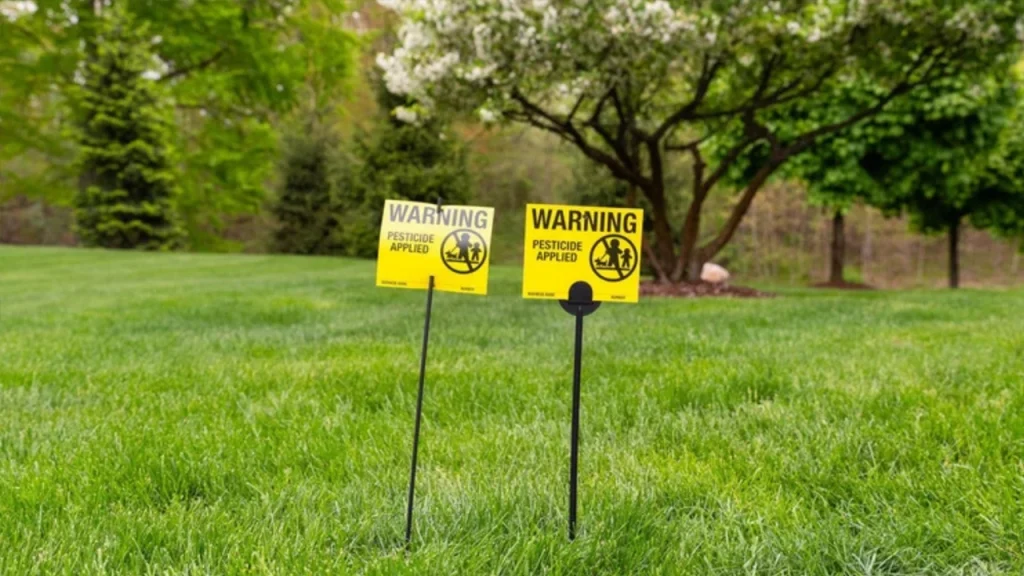
Yes. Colorado law requires a commercial pesticide applicator to post a sign at the conspicuous points of entry to the property at the time of the application. The rule comes from state law, not from city rules, so it applies the same way to a lawn in Fort Collins, Windsor, or Timnath.
The sign tells people a treatment happened. It doesn’t tell you how long to stay off the lawn. Our rule is to keep people and pets off the treated area for two to four hours, or until it’s dry.
When and where the sign goes up
The rule is in Colorado’s Pesticide Applicators’ Act, specifically C.R.S. § 35-10-112. For lawn and ornamental applications, the statute says the applicator must “at the time of application, post a sign or signs notifying the public of the application.” It also says the signs must be posted “at any conspicuous point or points of entry to the property receiving the application.”
In plain words, the sign goes up while the treatment is happening, not days later, and it goes where a person would step onto the property. The statute says “sign or signs” and “point or points of entry,” so a property with more than one way in can need more than one sign. The sections of the statute that cover lawn and ornamental applications set the placement themselves. A separate paragraph covers aquatic applications, where the state agriculture commissioner sets the placement by rule.
What the sign has to say
The same statute spells out the sign itself, not only the requirement to post one. It has to be water resistant and at least 4 inches tall and 5 inches wide. It has to use black lettering and symbols on a bright yellow background, and it has to include four things:
- The word WARNING in at least 60-point bold type.
- The words PESTICIDES APPLIED in at least 24-point bold type.
- A circle at least 2 inches across with a diagonal slash over an adult, a child, and a dog.
- The name of the applicator that made the application, in at least 18-point bold type.
The statute says each sign shall contain this information, so a sign in Windsor looks the same as a sign in Fort Collins or Timnath. Because the applicator’s name is required on the sign, you can always tell which company treated the lawn next door.
One extra rule for commercial properties
The statute adds a second set of details for one situation: when an applicator treats a commercial property and no owner or owner’s agent is there. In that case, the sign must also carry the applicator’s phone number, the name of the pesticide applied, and the date of the application, in at least 18-point bold type. The statute ties this extra rule to commercial property sites, so it is not the rule for a typical home lawn.
Why this surprises some homeowners
A lot of people assume a rule like this, if it exists at all, comes from their town or their HOA. It doesn’t. It comes from the state, so it applies whether a property is in established Fort Collins, a newer Windsor subdivision, or a brand-new Timnath development. A licensed applicator doesn’t skip the sign because the local town doesn’t ask for one, since the state already does.
Who the rule applies to
The statute covers commercial, registered limited commercial, and registered public applicators making applications in the turf and ornamental categories. That is the category any professional lawn treatment company falls into, and it includes us as a Northern Colorado organic lawn treatment company. It isn’t aimed at a homeowner using a bag of weed-and-feed on their own lawn. It’s a rule for businesses making applications for customers, which is also why the requirements are so detailed about size, wording, and color: it’s written for a company that applies products repeatedly, across many properties, not for a single one-off homeowner application.
How to use this as a homeowner
If a company has treated a lawn near you and you don’t see a sign, you can fairly ask them about it. The statute puts the duty on the applicator, so the question is a reasonable one to ask any company, not a complaint. If the sign is up and you want to know what it means, the three items to look for are the WARNING wording, the PESTICIDES APPLIED wording, and the company name at the bottom.
This is one of the more black-and-white rules in this business, and we like that about it. There’s no gray area. If you ever have a question about what’s posted on your own lawn after we’ve been there, just ask.
Clean Air Lawn Care Northern Colorado is owned by Dianne, Paul, and Luke DeLongchamps — a family business serving Fort Collins, Windsor, and Timnath with organic lawn treatments and solar-powered electric equipment.

