
Author: Dianne DeLongchamps
Organic vs. conventional lawn care in Colorado: which one is actually better?
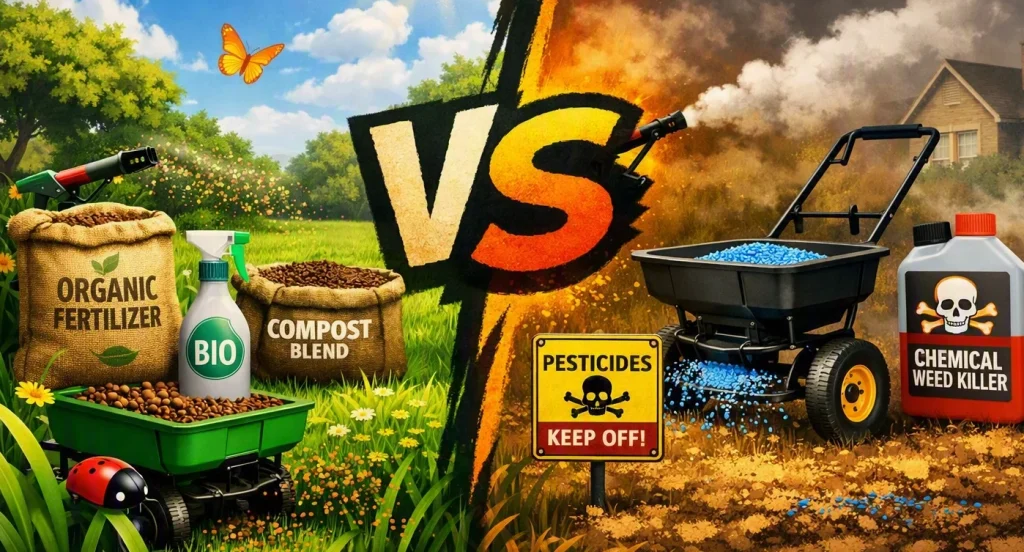
Conventional lawn care uses fast-acting synthetic fertilizers and pesticides to green grass quickly. Organic uses slow-release natural inputs that soil microorganisms convert into plant-available nutrients, adding organic matter back to the soil as it works. Conventional is faster and cheaper per visit. Organic is slower and builds the soil underneath the grass.
Here’s what that looks like on a Clean Air Lawn Care route in Fort Collins, Windsor, and Timnath: custom organic fertilizers and organic soil builders, non-toxic. Bio-based weed control including Moose Juice, our own blend for the clover and dandelions that show up all over Northern Colorado. No 2,4-D, no dicamba, no MCPP. All-electric, solar-charged equipment. Luke’s (NOCO’s expert) baseline for every customer is mow at 3 inches minimum and 3.5 in July and August, water 1 to 2 inches a week across two to three deep waterings.
You’re probably standing in your yard with a quote in your hand right now. We get this question more than any other, so here’s the straight version.
What’s the difference between organic and conventional lawn care?
Conventional programs use synthetic fertilizers that deliver nitrogen, phosphorus and potassium straight to the grass in a form it absorbs almost immediately. That’s the deep-green flush within days. It works.
The tradeoff isn’t that synthetic fertilizer poisons your soil. It’s that it feeds the plant and puts no organic matter back. Year after year, the grass gets fed and the soil doesn’t get built.
Organic takes the long way around. CSU Extension: nutrients in organic fertilizers “are often in a form inaccessible to plant uptake and need to be converted by soil microorganisms into bioavailable forms.” Slower, but organic fertilizers “often result in the slower release of nutrients… and can also improve soil properties through the addition of organic matter” (CSU Extension). CSU’s PlantTalk 1619 says the same thing from the soil’s side: organic materials “break down into humus that builds the soil structure.”
How do organic and conventional compare on speed, cost, and weeds?
Speed. Conventional wins the short window giving visible green-up inside a week. Organic works on a longer curve, and Ohio State Extension says it plainly: organic methods “take longer to produce visible results in most cases.” We won’t argue with that.
Cost. Organic runs higher per visit. The materials cost more to source and apply. The math shifts over several seasons as the soil does more of the work.
What goes down. Our organic lawn fertilization is custom organic fertilizers and organic soil builders, non-toxic, aimed at what the soil can hold rather than a quick surface green-up.
Weeds. Synthetic herbicides are built for fast, broad knockdown. Our natural weed control is soil-first. Our natural pre-emergents and signature Moose Juice work best when paired with a higher mowing height, which naturally shades out germinating weed seeds. This preventative approach relies on consistency to deliver the best results.
Equipment. Everything we run is solar-powered electric. No fumes, zero tailpipe emissions, and nobody on your street is woken up at 7 a.m.
Does organic lawn care work in Colorado soil?
Two things about Northern Colorado that most lawn advice online ignores.
Our soil is alkaline. CSU: “In Colorado, many of our soils are alkaline with a pH of 7.0 to 8.3.” A lot of organic lawn advice was written for acidic soil and doesn’t work here — bone meal being the classic example, covered in [What’s In Organic Fertilizer, and How Does It Feed the Soil Differently?]
Our soil is compacted. CSU’s Colorado Master Gardener notes call soil compaction “the primary factor limiting plant growth in landscape soils.” Not nutrients. Compaction. That’s why we start there. Timing windows here are also narrower than a national treatment calendar accounts for.
So which one should you choose?
If you’re listing your house next month, a synthetic program will green it up faster. That’s a real answer and we’d rather give it to you than sell you something that won’t do what you need in the time you have.
If you’re staying put and thinking about the next three to five years, organics are built for that. It focuses on the soil and the roots, ensuring your lawn actually thrives through a brutal July heat stretch.
Luke and I get asked this question in driveways all summer long, and we’ve never once tried to talk someone out of a decision that was right for their situation. If you want us to walk your yard and talk it through, we’re around.
Clean Air Lawn Care Northern Colorado is owned by Dianne, Paul, and Luke DeLongchamps — a family business serving Fort Collins, Windsor, and Timnath with organic lawn treatments and solar-powered electric equipment.

