
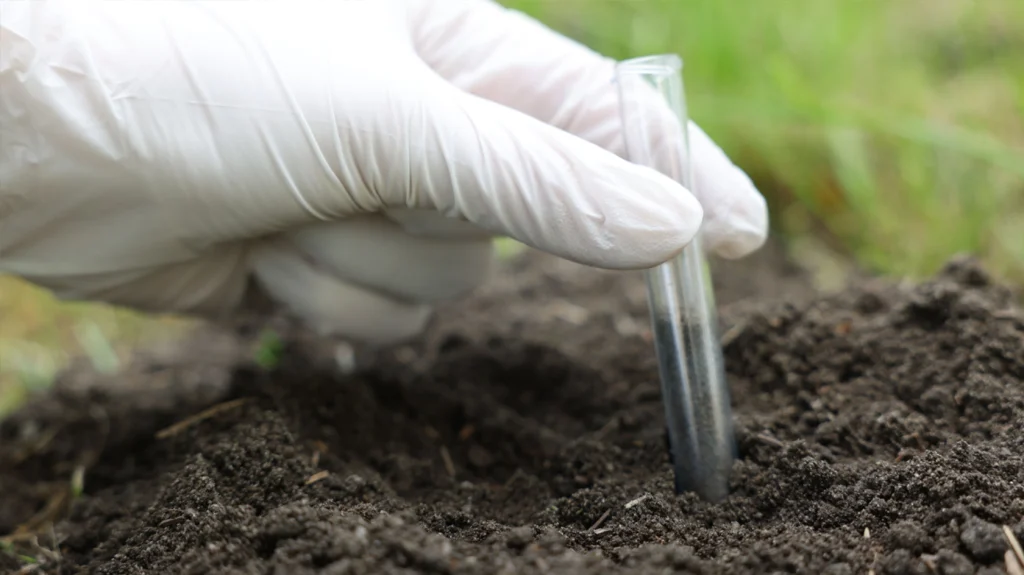
Do I need to test my soil before fall treatments?
A soil test isn’t required before every fall treatment, but it’s worth doing every few years, or any time a lawn isn’t responding well to fertilizer, because it shows the pH, nutrient levels and organic matter content that Colorado’s alkaline native soils can otherwise hide. Colorado State University’s own Soil, Water and Plant Testing Laboratory offers a basic residential test, Test S2, for $40 per sample, covering pH, soluble salts, organic matter, nitrate-nitrogen, phosphorus, potassium and sulfate-sulfur, subject to a $25 minimum charge per order.
Clean Air Lawn Care does not perform soil testing itself. Our own approach to fall soil health for Fort Collins, Windsor and Timnath customers is built around core aeration, overseeding and compost topdressing, done in both fall and spring, with fall positioned to set a lawn up for the strongest spring results, alongside our organic fertilization program.
What does a soil test tell you?
Colorado soils commonly run alkaline, in the 7.0 to 8.3 range, largely because of built-up calcium carbonate and low regional rainfall. In very acidic or very alkaline soils, some nutrients convert into forms that are harder for plants to absorb, which can look like a deficiency even when the nutrient is technically present in the ground. A standard test like CSU’s Test S2 also reports organic matter content and levels of nitrate-nitrogen, phosphorus, potassium and sulfate-sulfur, giving a much more specific picture than a general regional guess would.
Why does Colorado’s alkaline soil make iron a particular issue?
In alkaline soils, iron is present in a chemical form less usable by plants, even when the soil technically contains plenty of it. PlantTalk Colorado describes the visible symptom, called iron chlorosis, as a leaf turning yellow while its veins stay green, and in advanced stages, brown, scorched patches of leaf tissue. A soil test confirms whether iron availability, rather than a straightforward nitrogen shortage, is behind a yellowing lawn.
When is soil testing especially worth doing?
- Before starting a new fertilization program, so the plan is built around actual soil conditions instead of general averages
- If a lawn isn’t responding well to fertilizer despite consistent watering and mowing
- Every few years as general maintenance, since soil chemistry shifts gradually with fertilization, irrigation water and organic matter changes over time
- After a new sod installation or major renovation, to know exactly what the starting point looks like
When is testing probably unnecessary?
If a lawn has been consistently healthy, has responded well to its current fertilization program, and was tested within roughly the last several years, retesting before this fall’s treatments usually isn’t necessary. Soil chemistry generally doesn’t swing dramatically from one season to the next for most residential lawns.
How do results change a fall fertilization plan?
A lawn testing low in organic matter benefits more from compost and an organic fertilizer focused on building soil biology. A lawn showing an iron deficiency, which shows up as yellowing even when iron is present in the soil, needs a different approach than a lawn with a straightforward nitrogen gap. Results are what make it possible to target a fall application to what a specific lawn is actually short on, instead of applying the same blend everywhere.
How do you get a soil test done?
CSU’s Soil, Water and Plant Testing Laboratory can be reached directly at soiltestinglab@colostate.edu or (970) 491-5061 to order a kit and confirm current turnaround times, which vary with the lab’s seasonal volume. Sampling early in fall gives the best chance of getting results back in time to inform this season’s fertilization instead of after the window has closed.
We’re big believers in building a fall plan around what a lawn’s soil actually needs rather than a one-size-fits-all program. If you’re curious about lab-level detail, CSU’s Soil, Water and Plant Testing Laboratory is an independent public resource. For our own part, aeration, overseeding and compost topdressing are how we build soil health for lawns here in Fort Collins, Windsor and Timnath, in both fall and spring.
Clean Air Lawn Care Northern Colorado is owned by Dianne, Paul, and Luke DeLongchamps — a family business serving Fort Collins, Windsor, and Timnath with organic lawn treatments and solar-powered electric equipment.

