
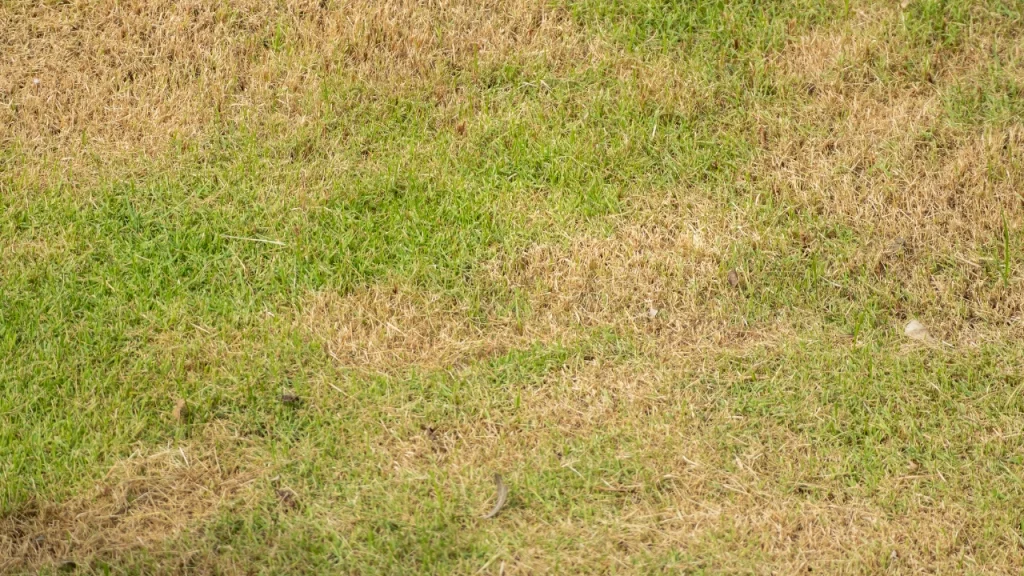
Why does my lawn still have disease spots once summer is supposedly over?
Plant disease doesn’t follow a calendar. It follows the weather. Dollar spot is a fungus, and CSU Extension’s PlantTalk Colorado says it gets going in hot, humid weather, especially when grass blades stay wet for a long stretch. Fort Collins can still get a warm, sticky week in September some years, and that’s enough to bring dollar spot back. So a spot that looks left over from July might actually be brand new.
Luke DeLongchamps walks lawns across Fort Collins, Windsor, and Timnath most weeks of the year. He sees the same lesion shape in June and in September, for the same reason both times: warm, humid air keeps water sitting on the grass overnight. Most of the lawns he checks are turf-type tall fescue or Kentucky bluegrass. PlantTalk Colorado’s dollar spot page names Kentucky bluegrass among the grasses the fungus affects, along with fine-leaf fescues, perennial ryegrass and a few warm-season types. It doesn’t single out turf-type tall fescue specifically, since fine-leaf fescue is a different grass than the tall fescue most Front Range lawns use. Dollar spot is a different disease than grub damage or necrotic ring spot, which we’ve covered in other posts, so it helps to match the exact symptom to the exact cause before treating anything.
What dollar spot actually looks like
PlantTalk describes it at two scales. Up close, on an individual blade, look for a white lesion pinched in the middle so it looks like a tiny hourglass, usually rimmed with a purple margin. Standing back, those lesions add up to small, silver-dollar-sized spots scattered across the lawn, not one big ring, and not a mat of dead grass that lifts up like sod. If what you’re seeing is a solid brown ring several feet wide, or a spot where the grass lifts away in a mat, that’s probably something else, and we’ve written about both of those separately.
Why September can still trigger it
Dollar spot needs two things: warm weather and wet grass blades. Front Range Septembers are unpredictable: some years cool off fast, other years hang onto warm, humid days, especially after it rains. PlantTalk doesn’t give an exact date for when dollar spot season ends. It just depends on the weather. So a warm, damp week in early fall can bring it back just as easily as one in July did.
What actually helps
PlantTalk points to a few specific things that help with dollar spot, not one spray that fixes everything:
- Core aeration, especially for lawns that are compacted or have a lot of thatch.
- Watering between about 9 p.m. and 8 a.m., so irrigation matches the dew period the air is already creating instead of adding extra wet hours on top of it.
- Resistant grass varieties, when you’re seeding or overseeding.
- Going easy on fungicide. PlantTalk treats it as a last resort, partly because dollar spot fungus can build up tolerance to it over time.
Our own fertilizer program uses organic, non-toxic ingredients instead of a fast-release synthetic product, and we time it to what the lawn actually needs rather than a fixed schedule. A lawn that isn’t starved or pushed into soft, fast growth tends to handle stress better in general. PlantTalk’s own advice for dollar spot focuses on aeration, watering timing, and grass variety, though, not fertilizer.
When it is not dollar spot
Not every fall spot is a fungus. Drought stress, a dog’s favorite spot, or a mower cutting too low can all leave a bleached or brown patch that looks similar from a distance. If you see a big ring instead of small scattered spots, or the grass pulls up with dead roots attached, that’s a different conversation, and it’s exactly the kind of thing Luke sorts out on a site visit before recommending anything.
September in Northern Colorado always throws us a surprise week of heat and humidity right when everyone thinks lawn season is winding down. If you are seeing small bleached spots scattered through your Fort Collins, Windsor or Timnath lawn right now, do not assume it is left over from summer. Send us a photo and we will help you figure out what you are actually looking at before you spend money treating the wrong thing.
Clean Air Lawn Care Northern Colorado is owned by Dianne, Paul, and Luke DeLongchamps — a family business serving Fort Collins, Windsor, and Timnath with organic lawn treatments and solar-powered electric equipment.

