
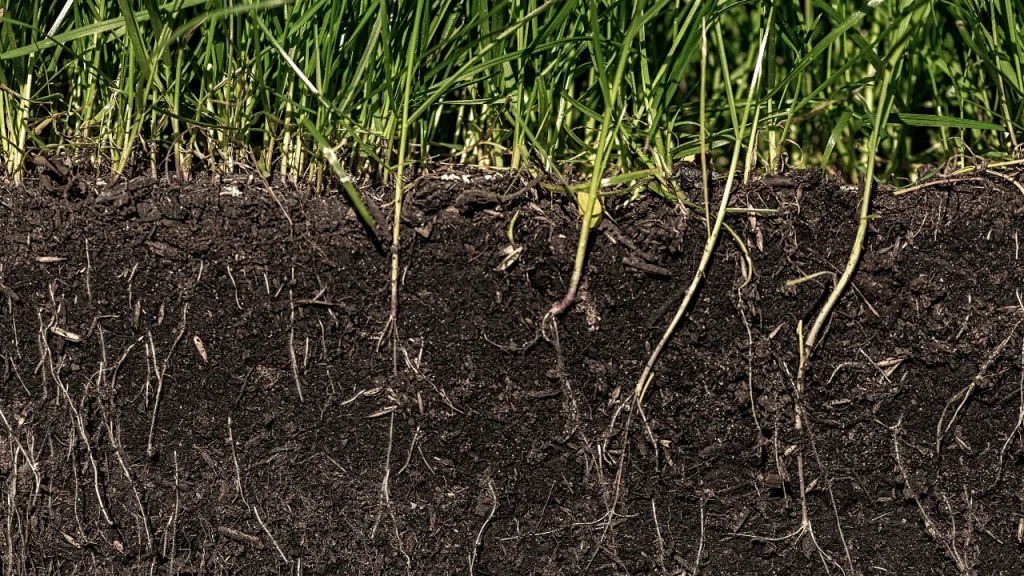
How can I improve my soil naturally before winter?
Colorado lawn soil can be improved naturally before winter by relieving compaction, adding organic matter through compost or fine grass clippings, and feeding the soil life with an organic fertilizer instead of a synthetic, quick-release one. CSU Extension’s guidance puts compacted landscape soils at around 1 percent organic matter, well below the 4 to 5 percent found in well-managed soil, which is exactly why fall soil-building work matters here.
Luke and I think about fall as the best time of year to invest in the soil itself, not just the grass sitting on top of it. It’s one of the areas where an organic approach does something different than a synthetic quick fix. Clean Air Lawn Care’s organic fertilizer is non-toxic and built to feed that soil life directly, which is the mechanism behind everything in this post.
Why does organic matter matter so much in Colorado soil specifically?
CSU Extension’s GardenNotes on soils and soil amendments puts typical organic matter in well-managed western soils at 1 to 5 percent, with compacted landscape soil often sitting at the low end around 1 percent. At 4 to 5 percent organic matter, soil releases enough nitrogen on its own that extra fertilizer often isn’t even needed. Below 2 percent, nitrogen release from the soil isn’t enough by itself. Front Range clay soils tend to run low on this scale, which is part of why building organic matter is an ongoing project here rather than a one-time fix.
What is in that organic matter, biologically speaking?
Healthy soil is full of life: bacteria, fungi, tiny worms called nematodes, and more, and that living population is what breaks organic material down into forms a grass plant can absorb, a process CSU Extension calls mineralization. Without those organisms, the nutrients locked in organic matter stay in forms a plant simply can’t use. (Our companion post on soil microbes goes deeper into exactly what’s living in your lawn’s soil.)
How does compost or topdressing help?
CSU Extension’s guidance on soil and organic matter says organic matter improves soil structure by helping soil particles clump together, which improves how well water and air move through the soil and gives it a higher water- and nutrient-holding capacity over time. CSU Extension’s GardenNotes on soil testing puts a number on the payoff: soil releases an estimated half a pound of nitrogen per 1,000 square feet during the growing season for each 1 percent of organic matter it contains. A lawn at 4 to 5 percent organic matter can release roughly 2 to 2.5 pounds of nitrogen per 1,000 square feet on its own across a season, which is close to what a full fertility program would otherwise need to supply. Soil at 2 to 3 percent releases about half that, and still needs supplemental fertilizer to make up the difference.
What is aeration’s role in soil improvement?
A summer of foot traffic, mowing equipment, kids and dogs compacts Front Range clay soils by fall. PlantTalk Colorado says aeration relieves that compaction and helps water and fertilizer move into the root zone, and names spring and fall as the best times of year to do it. Pulling actual soil cores, rather than just poking holes, is the technique CSU Extension recommends for real results. Clean Air Lawn Care performs core aeration, along with overseeding and compost topdressing, as one fall visit for customers, and offers the same service in spring.
What else is worth doing before winter?
- Overseed thin spots while soil is still warm enough for grass seed to grow. CSU Extension advises against seeding after the first fall frost, since young seedlings are unlikely to survive winter.
- Clear fallen leaves and debris regularly, instead of letting them mat down and smother grass.
- Avoid heavy digging or regrading late in the season, which can undo soil structure work already done.
- Pair aeration with compost topdressing, which works organic matter directly into those newly opened soil channels instead of leaving it sitting on the surface.
Does soil structure matter as much as soil nutrients?
It does. Certain beneficial soil fungi called mycorrhizae produce a compound called glomalin, which glues tiny clay particles together into larger clumps, directly improving the space and airflow that compacted Front Range clay is usually short on. That structural benefit is separate from, and just as important as, the nutrient benefits organic matter provides. Even a well-fed lawn struggles if water and air can’t move through the soil around its roots.
Soil health is honestly the thing Luke and I get the most excited talking about, because it’s the foundation everything else builds on. A lawn can look fine on top for a while with poor soil underneath, but it’s always working uphill. If you want your soil, not just your grass, in better shape before winter hits Fort Collins, Windsor or Timnath, we’d love to help you think through a plan.
Clean Air Lawn Care Northern Colorado is owned by Dianne, Paul, and Luke DeLongchamps — a family business serving Fort Collins, Windsor, and Timnath with organic lawn treatments and solar-powered electric equipment.

